
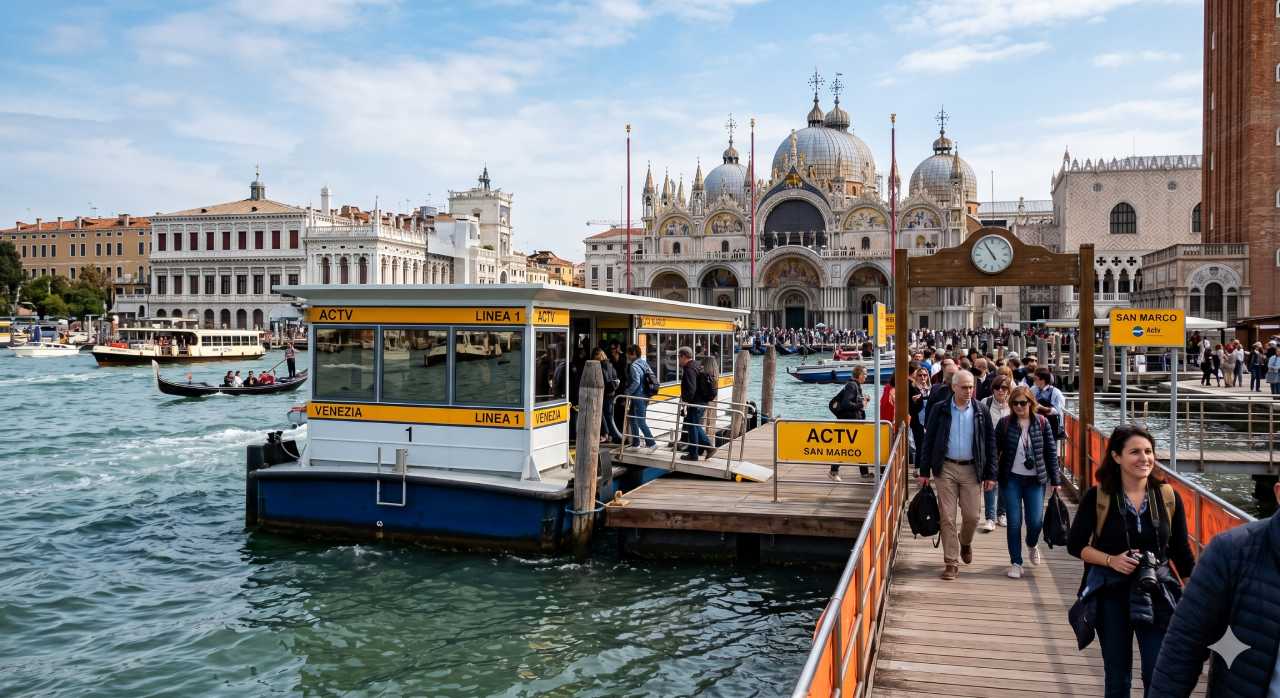
Taking a vaporetto (water bus) to St. Mark’s Basilica is one of the quintessential experiences of visiting Venice. Operated by the ACTV public transit system, these floating buses glide through the historic canals, offering a scenic and efficient way to reach the heart of the city.
Whether you are arriving from the Santa Lucia train station, the car parking hubs, or another district in the Venetian lagoon, this comprehensive guide covers everything you need to know about routes, stops, travel times, ticketing, and whether the water bus is truly the best option for your itinerary.
| St Mark’s | Price | Ticket |
|---|---|---|
| Entrance + Pala d’Oro + Terrace | €29.49 | Book Online |
| Guided Tour | €31.90 | Book Online |
| Entrance + Doge’s Palace | €69.90 | Book Online |
| Entrance + Bell Tower | €56.00 | Book Online |
| St. Mark’s Square Pass | €86.90 | Book Online |
| The Venice Pass | €92.50 | Book Online |
How Long Does It Take to Go to St. Mark’s Basilica?
The duration of your water bus journey depends entirely on your starting location and whether you board a local or express boat.
Venice’s waterways have strict speed limits to protect the foundations of historic buildings, so travel by water is leisurely.
| Starting Point | Vaporetto Line | Approximate Travel Time |
|---|---|---|
| Piazzale Roma (Bus/Car Hub) | Line 2 (Express via Grand Canal) | 25 – 30 minutes |
| Piazzale Roma (Bus/Car Hub) | Line 5.1 (Via Giudecca Canal) | 20 – 25 minutes |
| Piazzale Roma (Bus/Car Hub) | Line 1 (Local via Grand Canal) | 40 – 45 minutes |
| Santa Lucia Train Station | Line 2 (Express) | 20 – 25 minutes |
| Santa Lucia Train Station | Line 1 (Local) | 35 – 40 minutes |
| Rialto Bridge | Line 1 or Line 2 | 10 – 15 minutes |
| Lido di Venezia (S.M.E. Dock) | Line 1, 2, or 14 | 15 minutes |
| Murano (Colonna Dock) | Line 4.1 or Line 7 | 25 – 30 minutes |
Pro Tip: If you are boarding at the train station or Piazzale Roma during peak morning hours (9:00 AM to 11:30 AM), expect long lines at the docks. You may have to wait for a second or third boat to arrive before there is room to board, which can add 15 to 20 minutes to your total transit time.
What is the Vaporetto Stop at St. Mark’s Basilica?
There is no single dock named precisely after the basilica itself; instead, several major vaporetto stops serve the broader Piazza San Marco (St. Mark’s Square) area. Because St. Mark’s Basilica sits directly on the square, any of these docks will put you within a 2- to 5-minute walk of the church’s main entrance.
Depending on the line you take and the direction you are coming from, you will disembark at one of the following interconnected docks along the San Marco waterfront:
1. San Marco Vallaresso
Located directly to the west of St. Mark’s Square, near the historic Harry’s Bar. Disembarking here provides an entry path right past the Correr Museum and straight into the western end of the piazza. It offers a stunning view as the open square unfolds before you.
2. San Marco Giardinetti
Situated slightly east of Vallaresso, right next to the Royal Gardens (Giardini Reali). This stop is highly convenient, serving as a primary hub for several major lines navigating the Grand Canal. From the pier, you simply walk along the waterfront promenade and turn left into the square.
3. San Marco San Zaccaria
Located further east down the promenade (Riva degli Schiavoni), just past the Doge’s Palace and across the prominent Paglia Bridge. This is the largest docking complex in the area, consisting of multiple floating piers labeled with letters (A through F). It primarily serves express routes, outer-lagoon lines, and boats coming from the Lido or the cruise terminals. While it requires the longest walk to the basilica compared to the other two stops, it is still an easy 5-minute walk along the water with no major staircases to navigate except for the wide, stepped bridge over the canal.
How to Go to St. Mark’s Basilica with a Vaporetto
Getting to the basilica is remarkably straightforward because nearly all primary tourist routes in Venice converge at Piazza San Marco. Below are the most common starting points and the exact vaporetto lines required to reach the destination.
Arriving from the Main Transportation Hubs
If you are coming from outside Venice, you will likely start your journey at Stazione Ferrovia Santa Lucia (the central train station) or Piazzale Roma (the bus terminal and car parking area).
Arriving from Other Venetian Neighborhoods or Islands
Do I Need a Ticket for the Vaporetto?
Yes, you absolutely need a ticket before boarding a vaporetto. The transit network is strictly monitored, and riding without a validated ticket results in heavy, on-the-spot fines.
Youth Discount Note: If you are between the ages of 6 and 29, you can purchase a Rolling Venice Card for a small fee, which grants a significant discount on the 72-hour transport pass (reducing it to around €27.00). Children under the age of 6 travel completely free of charge.
Is the Vaporetto the Best Option to Go to St. Mark’s Basilica?
While the vaporetto is highly reliable and iconic, whether it is the best option depends on your physical mobility, your budget, where you are staying, and what you want out of your Venetian experience.
When the Vaporetto is the Best Option
When Walking is a Better Option
Summary Comparison: Vaporetto vs. Walking
| Metric | Vaporetto (Line 1 or 2) | Walking (Via City Center) |
|---|---|---|
| Cost | €9.50 per person (one-way) | Completely Free |
| Time (from Train Station) | 25 to 45 minutes | 30 to 40 minutes |
| Comfort Level | Seated or standing on water; can get very crowded. | Continuous movement over steps and stone paving. |
| Views | Grand Canal palaces, open lagoon waters. | Hidden alleyways, local shops, small neighborhood canals. |
Ultimately, a balanced approach is usually best for most travelers. Consider taking the vaporetto from the train station to St. Mark’s Basilica when you first arrive to enjoy the classic views of the Grand Canal and save your energy. Once you have finished touring the basilica and the Doge’s Palace, skip the return boat ticket and wander back to your destination on foot through the winding pathways of the San Marco and Cannaregio districts.
1. Which vaporetto line is the fastest from the train station to St. Mark’s?
Line 2 is the fastest route down the Grand Canal, taking about 20 to 25 minutes. Alternatively, Line 5.1 travels around the outside of the city via the Giudecca Canal and reaches San Marco in roughly the same time, bypassing the crowded Grand Canal entirely.
2. Can I buy vaporetto tickets directly on the boat?
Generally, no. You are expected to purchase and validate your ticket at the pier before boarding. In rare circumstances at smaller, unmanned docks, you may board and immediately notify the crew to buy a ticket, but doing so incorrectly can result in a steep fine. It is always safest to buy tickets via the automated machines or the official AVM/Actv app.
3. What is the difference between San Marco Vallaresso, Giardinetti, and San Zaccaria?
They are simply different docks serving the same general San Marco area.
4. Does the standard vaporetto ticket include entry to St. Mark’s Basilica?
No. The vaporetto is the public transit system run by ACTV, whereas the Basilica is a religious and historical site managed independently. You must purchase separate entry tickets for St. Mark’s Basilica, which is highly recommended to do online in advance to avoid massive lines.
5. Is a multi-day travel pass worth it just to see the Basilica?
If you only plan to take one round-trip to the Basilica and walk the rest of the time, a 24-hour pass (€25.00) is not worth it. However, if you plan to take three or more trips in a single day—or intend to visit outer islands like Murano, Burano, or Lido—the multi-day passes quickly pay for themselves.
6. Are vaporettos wheelchair accessible for getting to the Basilica?
Yes, the vast majority of ACTV vaporettos are wheelchair accessible, and the main docks serving San Marco (Vallaresso and Giardinetti) offer level boarding. The walk from these specific docks into St. Mark’s Square does not require crossing any stepped bridges.
7. How late do the vaporettos run to and from San Marco?
Main lines like Line 1 run until approximately midnight. After the regular schedule ends, Venice operates a night boat network (indicated by the Line N), which runs all night long and connects San Marco to the train station, Piazzale Roma, and the Lido.
8. Can I take my luggage on the vaporetto to San Marco?
Yes. The standard ticket price includes one piece of large luggage (up to 150 cm as the sum of its three dimensions) and one small hand luggage item. If you are traveling with excessive baggage, you may be required to purchase an additional ticket for the luggage.
9. What happens if I forget to validate my ticket before boarding?
Failing to tap your ticket against the electronic reader before stepping onto the dock platform is treated the same as riding without a ticket. If a transit inspector checks your ticket, you will face an immediate, non-negotiable fine (often upwards of €50 plus the price of the ticket).
10. Is it better to sit inside or outside on the way to the Basilica?
If weather permits, try to snag the limited outdoor seating at the very front or back of the boat for unobstructed photo opportunities of the Grand Canal. However, note that some newer Line 2 boats have restricted bow access, leaving the open stern (back) or the open-air central standing areas as your best options.