
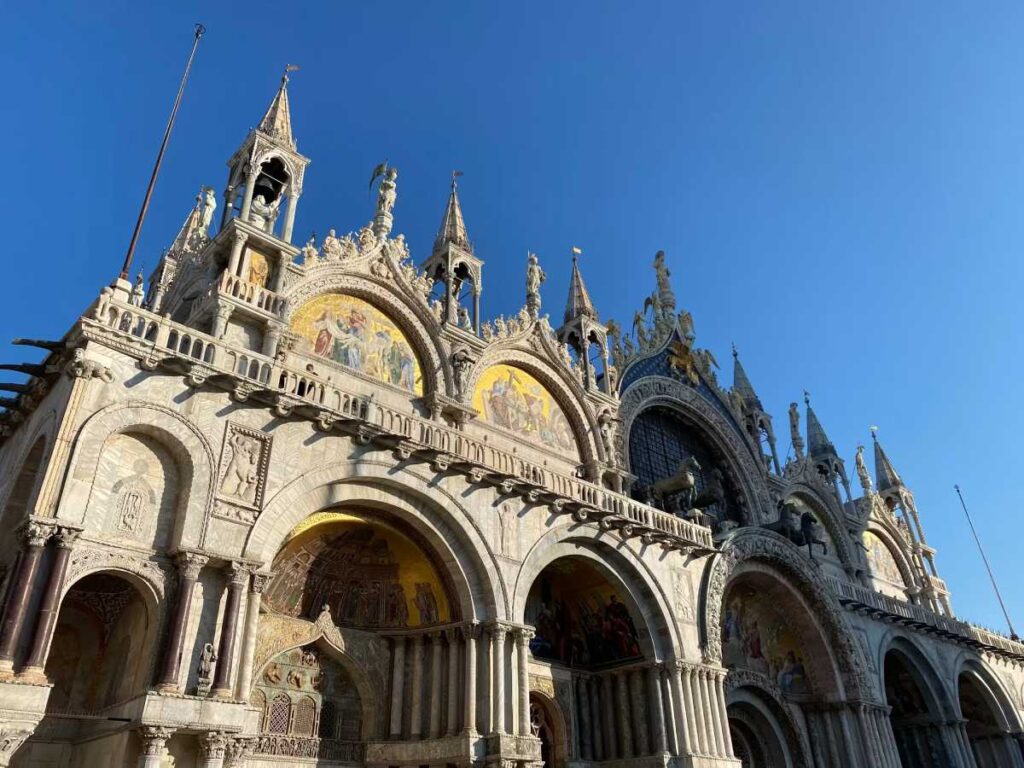
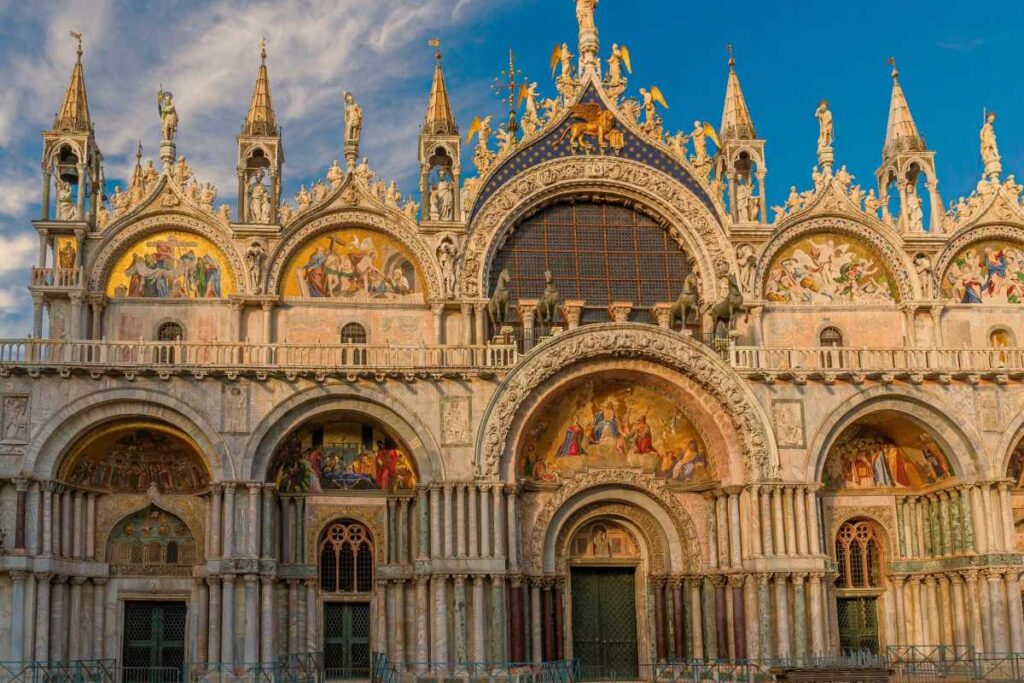
There is a specific moment in Venice when the heavy, mid-day heat breaks, the swarms of tour groups begin to retreat toward their cruise ships, and the Adriatic breeze rolls across the lagoon. If you are standing in the center of Piazza San Marco at exactly that moment, you will see something magical happen to the facade of the Basilica di San Marco. The setting sun hits the western front, and the thousands of square meters of gold leaf embedded in its mosaics catch the light, transforming the cathedral from a heavy stone monument into a glowing, iridescent treasure chest.
During my first trip to Venice, I made almost every classic rookie mistake in the book. I showed up at noon in the dead of July, stood in a soul-crushing line under a relentless sun, and wore a sleeveless shirt that almost got me turned away at the door. I learned the hard way that visiting this legendary Byzantine masterpiece requires more than just showing up; it takes strategy, planning, and a deep understanding of how the church operates.
| Day of the Week | Opening Hours |
|---|---|
| Monday to Saturday | 9:30 AM – 5:15 PM (Last entry at 4:45 PM) |
| Sundays and Bank Holidays | 2:00 PM – 5:15 PM (Last entry at 4:45 PM) |
To save you from the pitfalls I encountered, I have compiled this comprehensive, first-hand guide to navigating the opening times, the seasonal shifts, and the strict rules of St. Mark’s Basilica so you can experience it the way it was meant to be seen: in peace, awe, and complete comfort.
What Are the Opening Times of St. Mark’s Basilica?
Before you map out your day across the bridges and canals of Venice, you need to understand that the Basilica operates on two distinct schedules: one for standard tourist sightseeing and another for religious services.
On a standard day, the doors open for visitors according to a reliable schedule, but Sundays and public holidays throw a major curveball because the cathedral remains an active house of worship.
It is also worth noting that the interior sections—specifically the St. Mark’s Museum (Museo di San Marco), the Golden Altar (Pala d’Oro), and the Treasury—generally follow these same hours, but they may close their individual queues 15 to 30 minutes before the main basilica closes. If you plan to see everything, do not leave your entry until 4:30 PM.
Finding Your Perfect Moment: The Best Time of Day to Go
When people ask me what the absolute best hour to step inside the Basilica is, my answer is always the same: between 11:30 AM and 12:45 PM.
This might counter standard travel advice, which usually tells you to run to major monuments the second the doors open. While arriving at 9:15 AM does give you a shorter wait outside, the interior experience at noon is unmatched for one radiant reason: the lighting of the mosaics.
The interior of St. Mark’s is notoriously dark. To protect the centuries-old artwork and maintain a somber atmosphere, the interior floodlights are kept off for most of the day. However, every day around midday (typically from 11:30 AM to 12:45 PM, though this can slightly shift depending on church events), the custodians turn on the main interior lights.
When those lights flick on, the ceiling explodes into life. More than 8,000 square meters of mosaics—made with real gold leaf sandwiched between glass layers—reflect the light simultaneously. It feels less like looking at a painted ceiling and more like standing inside a burning star. If you visit outside of these hours, the domes are still beautiful, but they can look dark, shadowed, and difficult to appreciate in detail.
If you cannot make the noon lighting window, your next best option is late afternoon, around 4:00 PM. The crowds drop off dramatically, the cruise ship tours have largely vanished, and you can wander the interior with a fraction of the noise and congestion.
Framing Your Week: The Best Day of the Week to Go
If you have flexibility in your Venetian itinerary, try to schedule your interior visit for a Tuesday, Wednesday, or Thursday.
Venice is a magnet for weekend travelers, regional European tourists, and Italian day-trippers. Fridays and Mondays see a major surge in foot traffic as people stretch their weekends. Sundays are incredibly chaotic because the tourist window is compressed into just over three hours in the afternoon. This creates an intense bottleneck at the security gates.
By choosing a midweek day, you face fewer tour groups and a shorter queue at the main entrance. I highly recommend spending your weekend mornings exploring the quieter, residential sestieri (neighborhoods) like Cannaregio or Castello, and saving the heavy-hitting monuments of San Marco for a quiet Wednesday morning.
Beating the Seasonal Rush: Best Time of the Month and Year
Venice changes completely from month to month, transitioning from a packed, humid tourist hub to a quiet, misty, and evocative maritime city.
The Ideal Months: April, May, September, and October
To balance pleasant weather with manageable crowds, the absolute best times of the year to visit are the shoulder seasons: late spring (April to May) and early autumn (September to October). During these months, the temperatures hover comfortably in the high 60s and mid 70s Fahrenheit (18°C to 24°C). This makes walking across the stone piazzas pleasant, and the lines move efficiently.
The Low Season: November to February
If your primary goal is to avoid crowds at all costs, pack a heavy coat and book your trip for January or February (excluding the weeks of Carnaval) or November.
During the winter, Venice empties out. You can walk straight into the Basilica with virtually zero wait time. There is a profound, cinematic beauty to seeing St. Mark’s Square shrouded in morning lagoon fog, with the cathedral’s Gothic spires piercing through the mist.
However, winter visitors must be prepared for Acqua Alta (high water). When the tide rolls in, Piazza San Marco is the lowest point in the city, meaning it floods first. The church handles this by setting up raised wooden walkways (passerelle) across the square and inside the narthex of the basilica. It is an unforgettable adventure, but you will absolutely need waterproof boots!
The Months to Avoid: July and August
Unless you have no other choice, avoid mid-summer. The heat in July and August can be stifling, the humidity from the lagoon makes standing in an unconditioned line exhausting, and the city reaches peak tourist capacity. The interior of the basilica can get incredibly warm and humid with thousands of people moving through a historic stone structure with limited modern ventilation.
Navigating the Rules: Dress Code and Preparation
One of the most heartbreaking things to witness outside St. Mark’s is a traveler who has waited an hour in line, only to be turned away by the strict security guards at the door because of their clothing. St. Mark’s Basilica is not a museum; it is an active Catholic cathedral, and the clergy enforce a rigorous dress code out of respect for the sacred space.
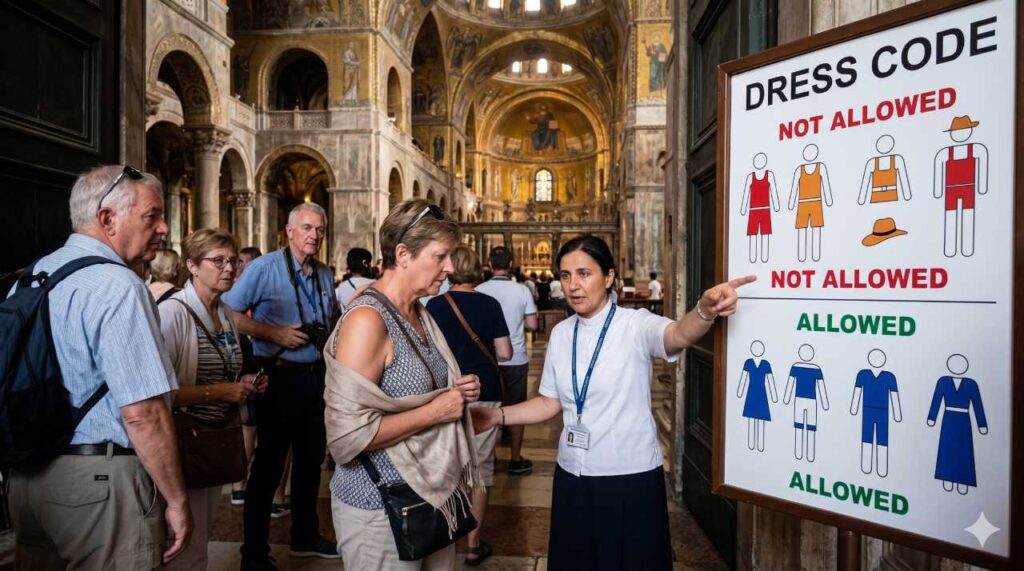
To avoid being rejected at the finish line, you must plan your outfit ahead of time. The rules are very specific:
If you are traveling during the hot summer months, you don’t have to wear heavy pants all day. My personal strategy is to pack a lightweight, linen scarf or a sarong in my daypack. Before I join the queue, I wrap the scarf around my shoulders or tie it around my waist to cover my knees. It takes two seconds, takes up almost no space in a bag, and saves you an immense amount of frustration. For a complete breakdown of what is and isn’t allowed, you can read the official guidelines on the St. Mark’s Basilica Dress Code Guide.
Master Your Visit: Essential FAQs and Insider Logistics
When you are planning a trip to a monument as complex as St. Mark’s, a dozen logistical questions inevitably pop up. Can I take photos? Where do I put my bags? How much does it cost?
Over the years, the rules have shifted to accommodate high crowd volumes and building security. Here are the core facts you need to know before you make your way to the entrance:
Is There a Luggage Policy?
Yes, and it is incredibly strict. You are not allowed to enter the Basilica with large backpacks, daypacks, suitcases, or bulky bags of any kind. Even a standard commuter backpack will be turned away. There is a dedicated, free luggage deposit station located just around the corner from the church in the Ateneo San Basso (in Calle San Basso).
Save yourself a massive headache by dropping your bags off before you line up. If you wait in the main line with a backpack, the guard will send you to the drop-off station, and you will have to line up all over again.
Can I Take Photos or Videos Inside?
Photography and video recording are completely prohibited inside the main nave of the Basilica. This rule is heavily enforced by roaming guards who will not hesitate to call you out publicly if you pull out your phone or DSLR. The goal is to preserve the quiet, contemplative nature of the church and to prevent crowds from bottlenecking as they try to take selfies.
However, once you pay the small additional fee to go upstairs to the Museo di San Marco and out onto the outdoor terrace, you are free to take as many pictures as you like. The terrace offers the absolute best panoramic views of Piazza San Marco, the Clock Tower, and the lagoon.
Don’t Waste Your Time in Venice: Buy Tickets in Advance
If there is only one piece of advice you take away from this entire guide, let it be this: do not show up in Venice planning to stand in the general admission ticket line.
| St Mark’s | Price | Ticket |
|---|---|---|
| Entrance + Pala d’Oro + Terrace | €29.49 | Book Online |
| Guided Tour | €31.90 | Book Online |
| Entrance + Doge’s Palace | €69.90 | Book Online |
| Entrance + Bell Tower | €56.00 | Book Online |
| St. Mark’s Square Pass | €86.90 | Book Online |
| The Venice Pass | €92.50 | Book Online |
Venice is a city built for slow exploration—for getting lost in quiet alleyways, sipping an espresso along a sleepy canal, and watching gondolas glide past. The absolute last thing you want to do with your limited hours in this magical city is spend two of them standing on hot, unshaded Istrian stone pavement in a line that stretches halfway across the piazza.
The general admission queue during the peak spring, summer, and autumn seasons can easily take anywhere from 45 minutes to over two hours. It is an exhausting, spirit-dampening experience that sets a stressful tone for the rest of your visit.
Fortunately, there is a simple escape hatch. The cathedral offers skip-the-line reservations that let you book a specific, dedicated entry time slot. When you buy your tickets ahead of time, you bypass the massive main queue entirely and walk right up to a dedicated entrance at your selected time. This turns a stressful waiting game into a seamless, elegant walk-in experience, leaving you with plenty of extra time to enjoy a glass of local Prosecco or explore the Doge’s Palace next door.
Before you finalize your itinerary, make sure to secure your entry voucher directly online through the primary reservation portal at St. Mark’s Basilica Tickets.
A Quick Reference Summary for Your Trip
To help you organize your day at a glance, here is a quick summary table of the key windows for your visit:
| Aspect | Best Option | Why It Matters |
| Time of Day | 11:30 AM – 12:45 PM | The interior mosaics are fully illuminated by floodlights. |
| Day of the Week | Tuesday – Thursday | Weekend crowds and regional day-trippers are at a minimum. |
| Time of the Year | April/May or Sept/Oct | Perfect balance of comfortable temperatures and manageable crowds. |
| Dress Code Strategy | Covered shoulders & knees | Strict security will deny entry for shorts or tank tops. |
| Bag Protocol | Drop at Calle San Basso first | Large bags and backpacks are strictly banned inside. |
By taking the time to plan your visit around the church’s unique rhythm, you can transform a standard sightseeing stop into an unforgettable encounter with history. Walking into that quiet, cavernous space when the midday light hits the gold leaf is a sensory memory that will stay with you long after you have boarded your water taxi back home. Keep your shoulders covered, lock in your tickets early, and get ready to witness one of the true visual wonders of the world.