
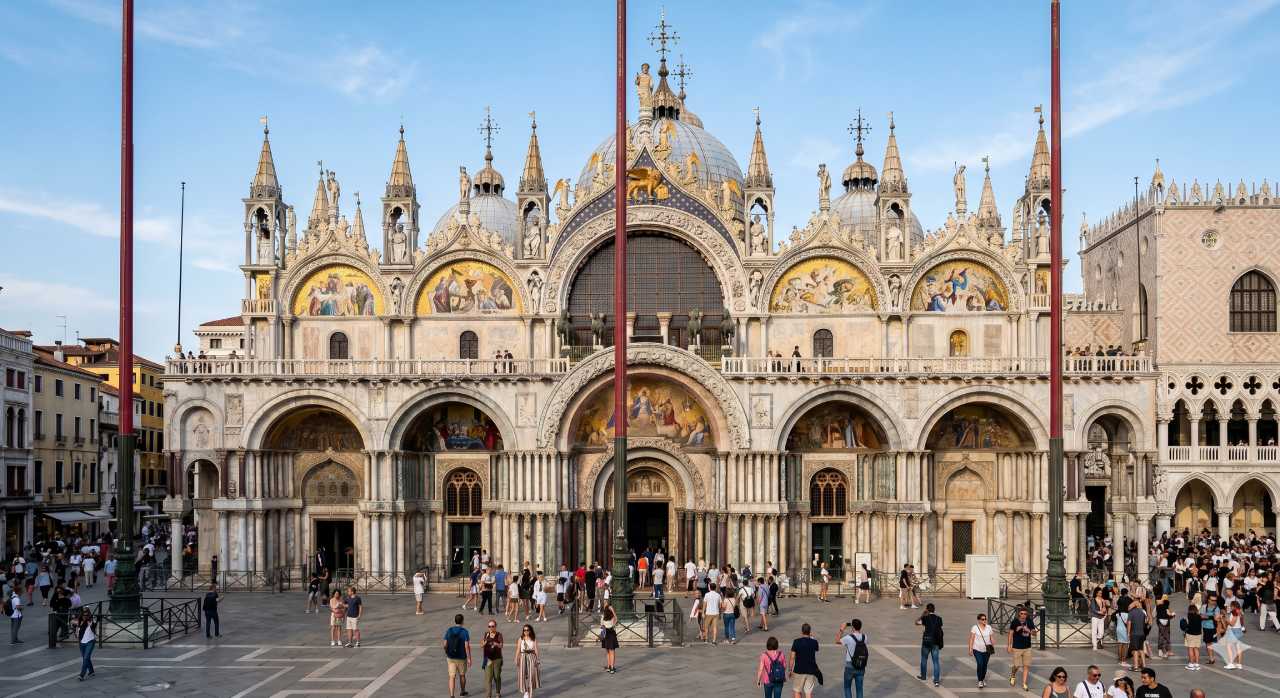
Tickets for the St Mark’s Basilica in Venice – Skip-the-line
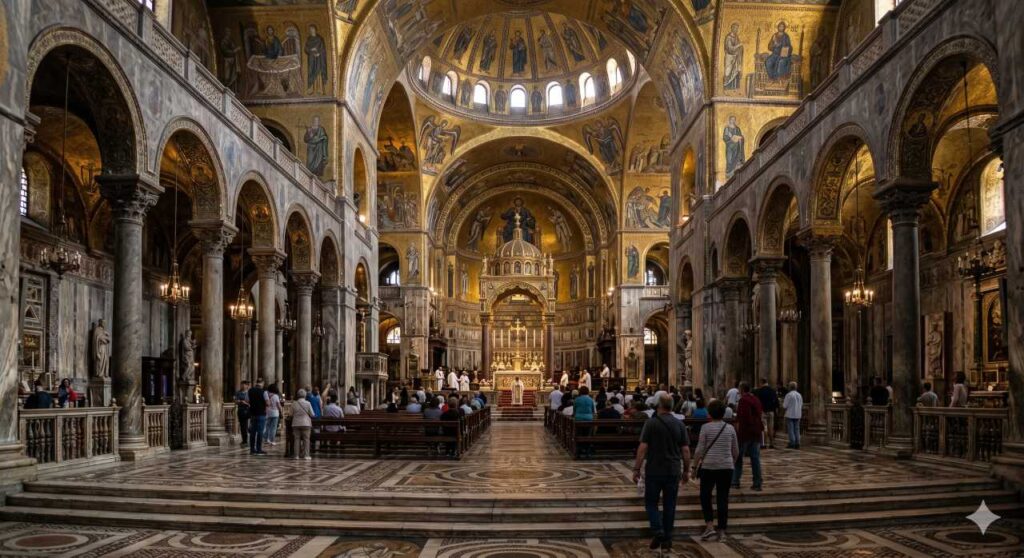
Upon passing through its ancient portals, visitors enter a realm of divine splendor. The interior is covered by more than 8,000 square meters of shimmering golden mosaics that cloak the upper walls, vaults, and soaring ceilings.
These mosaics, crafted over a span of eight centuries using real gold leaf sandwiched between glass layers, depict a vast narrative of Christian scripture, local legends, the life of St. Mark, and the profound theological vision of medieval Christendom.
Beneath your feet, an equally complex, undulating floor of inlaid geometric marble and porphyry stretches across the nave, mimicking the rolling waves of the lagoon that surrounds the city.
The Basilica is not merely a museum or a static monument; it is a living, breathing house of worship where centuries of history, art, and spirituality converge to leave an indelible impression on everyone who crosses its threshold.
🏛️ St. Mark’s Basilica Ticket Calculator
Select your preferred ticket tier, adjust your group size, and get an instant cost breakdown before booking your skip-the-line entry.
🔒 Official Tiqets Instant Mobile Tickets & Instant Confirmation
Can you visit the basilica for free?
No, not for sightseeing. General entry requires a paid ticket. Entrance is free only if you enter strictly to pray or attend mass via a dedicated side door, but you are confined to the worship area and cannot walk around to view the artwork.
What are the waiting lines without an advance ticket?
If you don’t pre-book a “skip-the-line” pass online, expect to wait in the main square queue:
Tickets for the St. Mark’s Cathedral
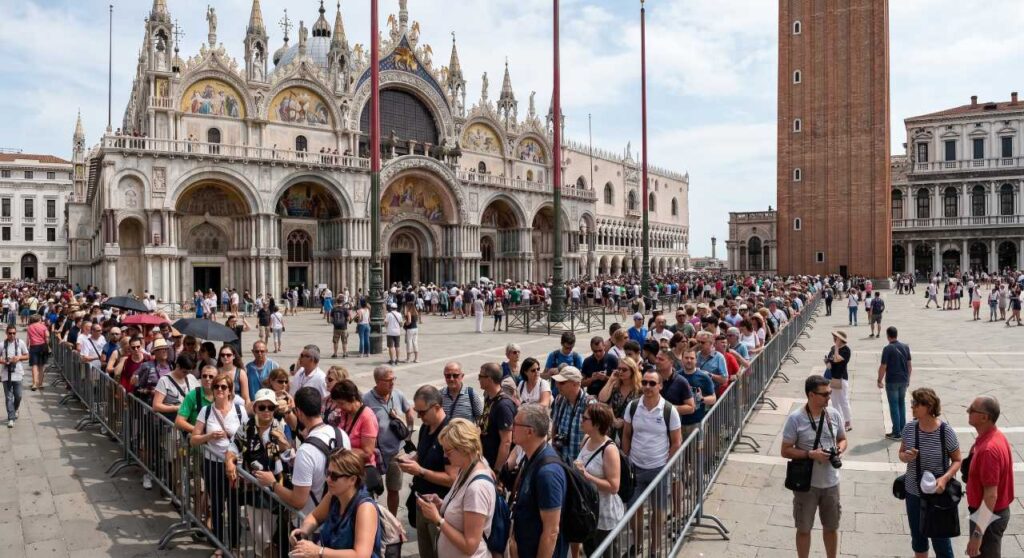
To preserve the delicate structural integrity of the ancient monuments and manage the high volume of daily global travelers, St. Mark’s Basilica operates using a structured system of entry tickets.
Securing your tickets online in advance is always the better choice, as buying them on the spot forces you to waste valuable time waiting in an extra queue just to make your purchase before you can even enter.
| St Mark’s | Price | Ticket |
|---|---|---|
| Entrance + Pala d’Oro + Terrace | €29.49 | Book Online |
| Guided Tour | €31.90 | Book Online |
| Entrance + Doge’s Palace | €69.90 | Book Online |
| Entrance + Bell Tower | €56.00 | Book Online |
| St. Mark’s Square Pass | €86.90 | Book Online |
| The Venice Pass | €92.50 | Book Online |
Why the Venice Pass is a Great Deal for St. Mark’s Basilica
Bundling your itinerary with the Venice Pass is highly advantageous for visitors planning to experience the city’s historic core. It streamlines the logistics of navigating Venice’s strict booking requirements while offering excellent financial and practical value.
1. Bypassing the Mandatory Booking Bottleneck
Since the complete removal of on-site ticket offices at St. Mark’s Basilica, entry requires a pre-booked, timed digital ticket. During peak travel seasons, these individual slots sell out weeks in advance. The Venice Pass secures your reservation automatically, granting you fast-track access through the dedicated Porta San Pietro entry line and bypassing the hours-long general admission queues wrapping around the square.
2. Comprehensive Financial Savings on Top Attractions
Purchasing standalone admissions for Venice’s primary landmarks quickly escalates in cost. The Venice Pass bundles the city’s essential highlights into a single price point, delivering an automatic discount compared to individual bookings. A standard pass covers:
3. Integrated Audio Guides and Neighborhood Navigation
Navigating the complex architecture and deep history of the Basilica can be overwhelming without context. The Venice Pass includes a comprehensive, downloadable digital audio guide app featuring expert historical commentary specifically tailored for both the Basilica and the Doge’s Palace. It also provides offline interactive maps of the city, eliminating the need to rent separate audio equipment on-site.
4. Added Value Perks and Ongoing Discounts
Beyond the primary inclusions, the pass issues a continuous 10% promotional discount code valid for secondary attractions, public transportation upgrades, or island excursions (such as Murano and Burano). This allows you to scale your sightseeing fluidly while maintaining structural savings throughout your stay.
Opening Times for the St. Mark’s Cathedral
St. Mark’s Basilica functions simultaneously as an active Catholic sanctuary and a major cultural heritage destination. Consequently, opening hours are divided between tourist sightseeing windows and dedicated hours for personal prayer and liturgical services.
General Sightseeing Operating Hours
Specialized Zone Exceptions
Dress Code for the St. Mark’s Cathedral
Because St. Mark’s Basilica is a sacred consecrated space of immense religious importance, all visitors must strictly adhere to a modest dress code. Security personnel stationed at the entrance gates conduct rigorous visual inspections of all guests. Failure to comply with these regulations will result in an immediate denial of entry, regardless of whether you hold a valid prepaid ticket.
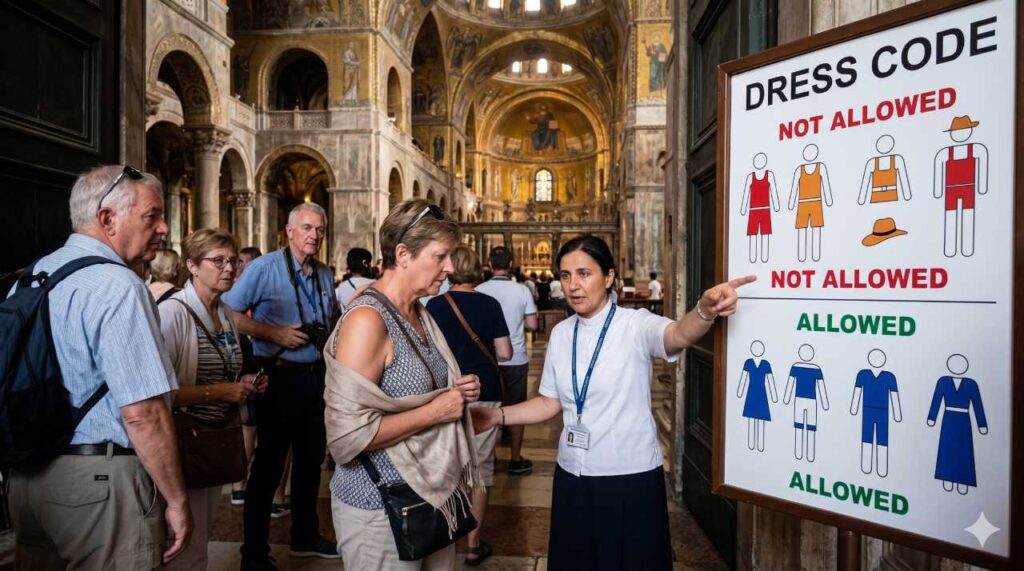
St. Mark’s Basilica Dress Code Scanner
St. Mark’s Basilica is an active place of worship with strict door checks. Visitors failing dress code are turned away without refunds.
Practical Tips for Entering the St. Mark’s Cathedral
To ensure your journey through the Golden Basilica is smooth, respectful, and completely hassle-free, please review these essential practical recommendations prior to your arrival at Piazza San Marco:
How to Get to the St. Mark’s Cathedral
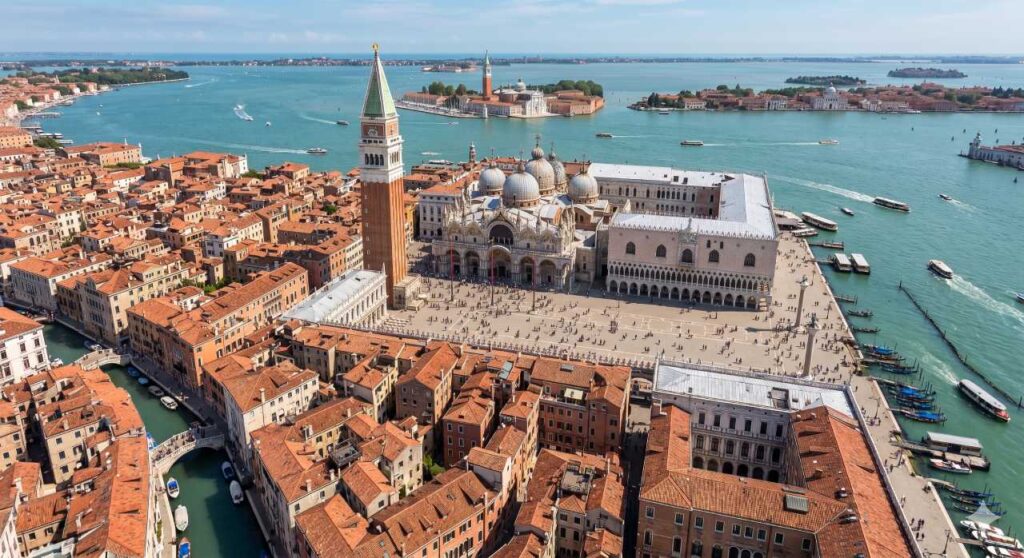
St. Mark’s Basilica is centrally located within the historic heart of Venice at Piazza San Marco, 328. Because the historic center of Venice is entirely car-free, the Basilica can only be reached on foot or via the city’s network of water public transport.
Travelling via Water Bus (Vaporetto)
The ACTV Vaporetto system is the most efficient method for navigating the Grand Canal and reaching the Basilica from major transit hubs:
Travelling on Foot
For those who prefer to absorb the atmosphere of Venice by walking, reaching Piazza San Marco on foot offers a wonderful look at the city’s labyrinth of canals and alleys. The route is clearly marked throughout the city by iconic yellow directional signs fixed to the corners of historic buildings.
History of the St. Mark’s Cathedral
The genesis of St. Mark’s Basilica is inextricably bound to an audacious tale of pious espionage, political ambition, and the rise of Venice as a Mediterranean superpower.
The Sacred Theft and the First Sanctuary (828–976)
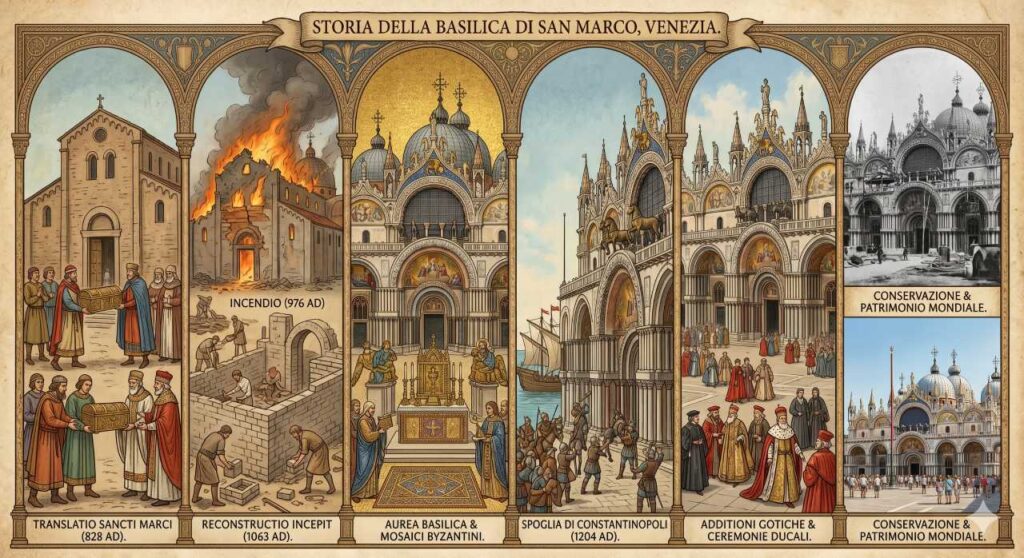
In the early 9th century, Venice was a growing maritime community eager to break free from the shadow of the Byzantine Empire and establish its own independent spiritual identity. At the time, the city’s patron saint was Saint Theodore, a minor Byzantine military figure. Venetian leadership desired a patron of grander, apostolic prestige.
The opportunity arose in 828 AD when two daring Venetian merchants, Rustico da Torcello and Buono da Malamocco, traveled to Alexandria, Egypt. There, they acquired the holy relics of Saint Mark the Evangelist from a local sanctuary threatened by political unrest. To smuggle the sacred remains past Muslim port officials, the merchants famously concealed the body beneath layers of pork and cabbage—items the inspectors refused to touch.
The safe arrival of Saint Mark’s relics in Venice was hailed as a miraculous sign of divine favor. The ruling Doge immediately ordered the construction of a dedicated chapel adjacent to the Doge’s Palace to house the sacred remains, effectively establishing Saint Mark as the perpetual protector and patron saint of Venice. This initial structure was a modest, fortified chapel. However, in 976 AD, a violent popular uprising against the tyrannical Doge Pietro IV Candiano sparked a massive fire that destroyed the palace and reduced the original church to ashes.
The Great Byzantine Reconstruction (1063–1094)
The foundations of the magnificent Basilica seen today were laid in 1063 under the visionary leadership of Doge Domenico Contarini. The Venetian Republic had grown immensely wealthy through maritime trade, and the new building was designed to serve as a physical manifestation of the state’s immense power, prestige, and financial fortune.
The architect, whose identity remains a mystery, discarded Western European architectural conventions, opting instead for a grand Byzantine layout modeled directly after Constantinople’s legendary imperial churches. The building was constructed using strong brickwork, which was then systematically veneered with rare, exotic marbles, columns, and capitals brought back by Venetian merchant fleets from across the known world. The new Basilica was officially consecrated with immense pomp and circumstance in 1094, a milestone marked by the miraculous “rediscovery” of Saint Mark’s relics, which had been hidden in a secret pillar to protect them during the long years of reconstruction.
The Age of Enrichment and Imperial Spoil (1204–1797)
For centuries following its consecration, St. Mark’s Basilica functioned strictly as the Doge’s Private Chapel and the state church of the Venetian Republic, rather than the official city cathedral (a title held by San Pietro di Castello until 1807). As a result, the building became the central canvas for showcasing the spoils of Venetian military victories.
The turning point for the Basilica’s interior and exterior opulence occurred in 1204, following the controversial Fourth Crusade. Under the leadership of the blind and elderly Doge Enrico Dandolo, Venetian forces sacked Constantinople. The triumphant fleets returned to Venice laden with an unimaginable wealth of imperial plunder. Among these treasures were hundreds of ancient columns made of rare porphyry and marble, exquisite enameled icons, and the legendary Four Bronze Horses (the Triumphal Quadriga), which were promptly mounted onto the central loggia of the Basilica’s facade as a public symbol of Venice’s dominance over the Eastern Empire.
Throughout the Renaissance and Baroque eras, the Basilica continued to evolve. While the core Byzantine structural design remained untouched, prominent Venetian masters, including Jacopo Sansovino and even masters of mosaic design, updated specific chapels, sculpted marble iconostases, and replaced damaged medieval mosaics with newer artworks based on cartoons drawn by Renaissance maestros like Titian and Tintoretto.
When the Venetian Republic finally fell to Napoleon Bonaparte in 1797, the Basilica transitioned from an exclusive symbol of ducal power into the official public Cathedral of Venice, opening its golden doors to the wider world as an immortal monument to a bygone empire.
Frequently Asked Questions
Everything you need to know before visiting St. Mark’s Basilica in Venice.
1. Is there an admission fee to enter St. Mark’s Basilica?
Yes. Additional fees apply for specific areas inside, such as the St. Mark’s Museum, the Loggia (outer terrace), and the Pala d’Oro.
2. Can I bring a backpack or large bag inside?
No. For security and structural preservation, all backpacks, luggage, large shoulder bags, and bulky parcels are strictly prohibited inside the Basilica. You will be turned away at the door if you have them.
You must check your large bags at a designated luggage storage facility near Piazza San Marco before joining the entry line. Small personal purses or clutches are permitted.
3. What is the dress code for entering the Cathedral?
The Basilica is an active, consecrated place of worship and enforces a strict dress code. Shoulders and knees must be completely covered for all visitors. Tank tops, shorts, miniskirts, midriff-baring tops, and beachwear are forbidden. Hats must be removed by men upon entering, and sunglasses should be taken off.
4. Can I take photos or videos inside the Basilica?
No. Photography and video recording are strictly prohibited inside the main sanctuary. This rule is in place to maintain a respectful environment for worshippers and to protect the ancient, delicate gold mosaics from flash damage. Selfie sticks and tripods are also banned.
Photography is allowed only from the outdoor terrace (Loggia dei Cavalli) if you purchase a ticket to the museum.
5. Where can I see the famous Bronze Horses?
The original Four Bronze Horses (the Triumphal Quadriga), plundered from Constantinople during the Fourth Crusade in 1204, are kept safely indoors on the upper floor inside the St. Mark’s Museum to protect them from air pollution. The four horses visible on the exterior facade of the building are exact replicas.
6. What is the Pala d’Oro and how do I see it?
The Pala d’Oro is the world-famous Byzantine altarpiece situated behind the high altar of the Basilica. It is a masterpiece of medieval goldsmithing, studded with thousands of real pearls, emeralds, sapphires, rubies, and exquisite cloisonné enamels. Viewing it requires a separate add-on ticket, which allows you to walk directly behind the altar.
7. How long are the wait times, and should I book online?
During the peak travel season (April to October), walk-in lines in Piazza San Marco can easily exceed one to two hours. It is highly recommended to book a timed-entry ticket online well in advance. This grants you access via a fast-track queue, reducing your wait time to just a few minutes for security screening.
8. Is the Basilica accessible for visitors with limited mobility?
Yes, the ground floor of the main Basilica is accessible to wheelchair users and visitors with limited mobility via ramps. However, the upper levels – including the St. Mark’s Museum, the outdoor Loggia terrace, and the summit of the Campanile (Bell Tower) – are reached via steep, historic staircases or specific narrow elevators that may require staff assistance.
9. Does the Basilica close during Acqua Alta (high tide)?
The Basilica is equipped with state-of-the-art glass flood barriers that successfully keep the interior dry during minor and moderate Acqua Alta events. However, during exceptionally severe historic high tides, the surrounding square may become deeply flooded, causing temporary closures or delayed opening hours. It is best to check local tidal forecasts during autumn and winter.
10. Can I enter the Basilica just to pray without buying a ticket?
Yes. Worshippers who wish to attend Mass, receive the sacraments, or pray privately can enter the Basilica for free without a tourist ticket. You must use the dedicated devotion entrance at the Porta dei Fiori on the north side of the building.
Security guards will direct you strictly to the side chapels reserved for prayer; sightseeing, roaming the nave, and touring the art assets are strictly forbidden via this route.
Ready to skip the queue in Piazza San Marco?
🎟️ Book Fast-Track Entry Tickets