
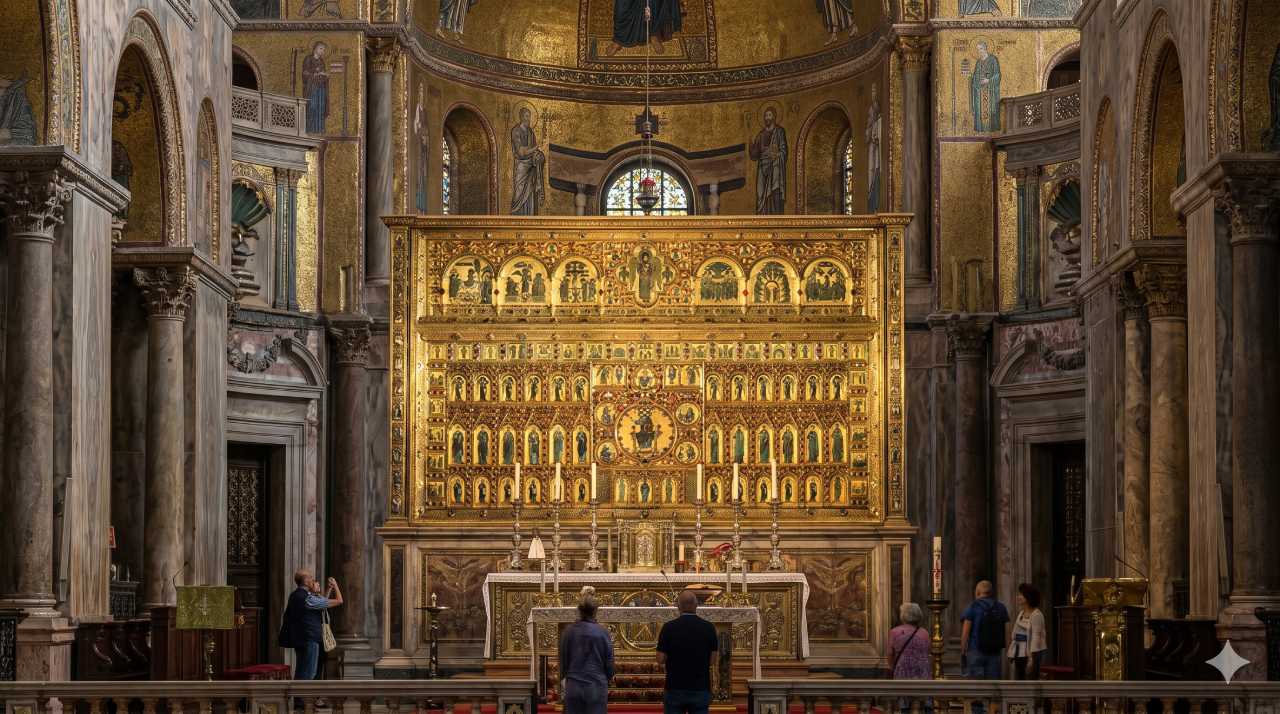
Among the cultural treasures of Venice, few objects encapsulate the city’s historical wealth, artistic ambition, and complex relationship with the Byzantine Empire as completely as the Pala d’Oro. Positioned behind the high altar of St. Mark’s Basilica (Basilica di San Marco), this magnificent, gem-encrusted altarpiece stands as one of the most celebrated and luxurious survivals of medieval goldsmithing and Byzantine enamelwork in existence.
Translated literally from the Italian as the “Golden Cloth” or “Golden Altarpiece” the Pala d’Oro is not merely a decorative screen; it is a complex, multi-layered historical document rendered in gold, silver, precious gemstones, and cloisonné enamel. For centuries, it served as the visual focal point of Venetian state liturgy, unveiled only during the most solemn religious feasts to dazzle visiting dignitaries, local citizens, and foreign merchants alike.
To understand the Pala d’Oro is to understand the soul of medieval Venice: a maritime republic that stood astride the East and the West, combining western European Gothic architecture and political governance with Eastern Christian artistic traditions, visual opulence, and liturgical solemnity.
| St Mark’s | Price | Ticket |
|---|---|---|
| Entrance + Pala d’Oro + Terrace | €29.49 | Book Online |
| Guided Tour | €31.90 | Book Online |
| Entrance + Doge’s Palace | €69.90 | Book Online |
| Entrance + Bell Tower | €56.00 | Book Online |
| St. Mark’s Square Pass | €86.90 | Book Online |
| The Venice Pass | €92.50 | Book Online |
What to Expect During the Visit
The viewing area for the Pala d’Oro is organized via a dedicated, one-way pedestrian path that guides visitors around the rear of the high altar. Because the space is enclosed, the crowd moves in a slow, continuous line.
Visitor Insight: To get the most out of your viewing experience, bring a small pair of compact binoculars or use the optical zoom on your camera. The lower registers are easy to examine with the naked eye, but the upper panels—such as the Archangel Michael and the narrative feast scenes—sit above eye level and contain tiny details that are best appreciated with magnification.
If you appreciate fine detail, historical continuity, and the physical manifestation of imperial wealth, taking the extra time to walk behind the altar is an indispensable part of the St. Mark’s experience.
What is the Pala d’Oro?
The Pala d’Oro is a massive, rectangular retable (an altarpiece structure placed behind an altar) constructed from sheets of gold and silver-gilt, which form the structural framework for hundreds of individual plaques, medallions, and decorative borders.
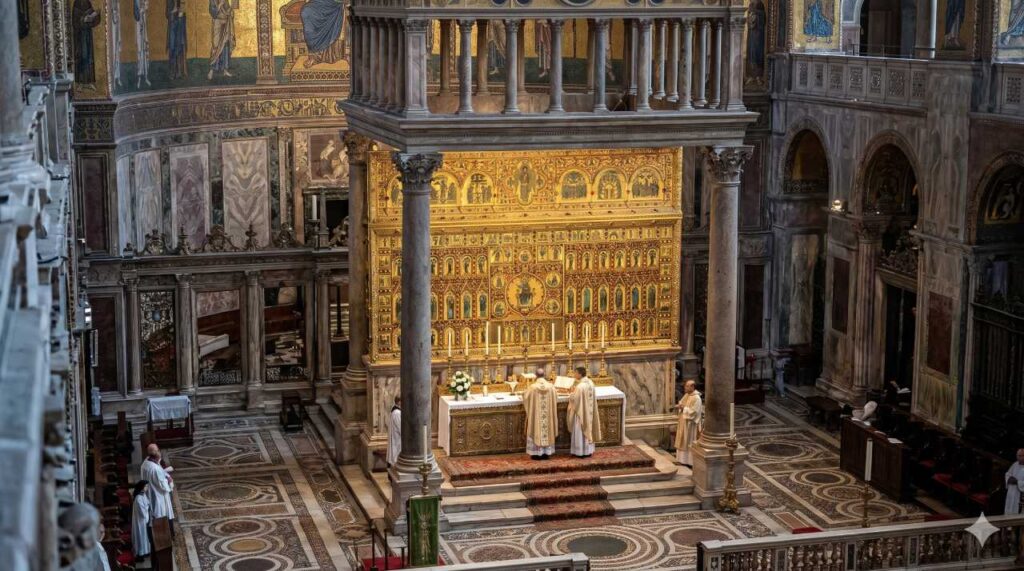
Its defining artistic feature is the extensive use of Byzantine cloisonné enamelwork—a painstaking technique where thin strips of wire are soldered to a metal base to create small cells (cloisons), which are then filled with colored glass paste and fired in a kiln.
The altarpiece is divided structurally and iconographically into two main horizontal zones:
The Upper Section (The Archangel Michael and the Feasts)
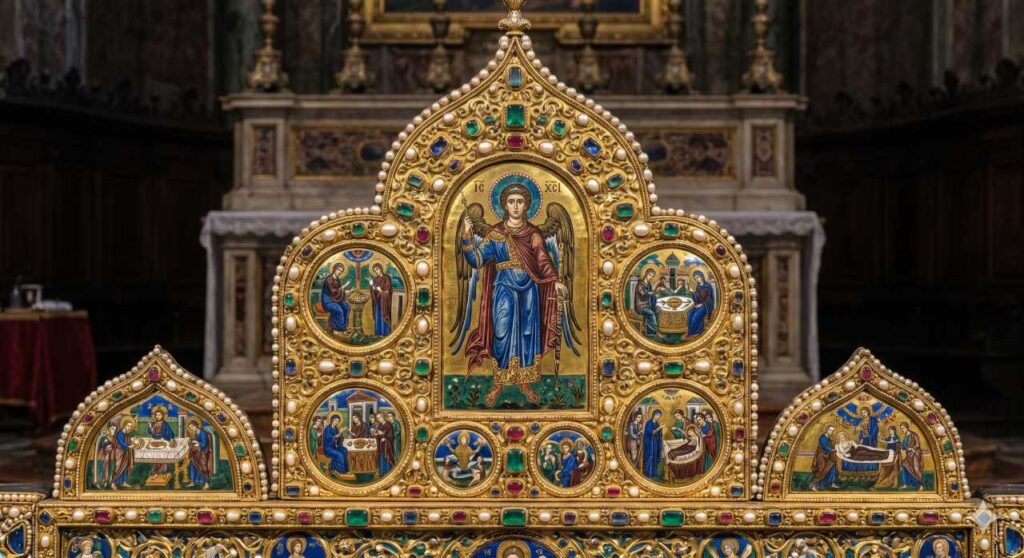
The top half of the Pala d’Oro is dominated by a large central medallion depicting the Archangel Michael, flanked by six arched panels illustrating pivotal narrative scenes from the life of Christ and the liturgical calendar:
These plaques are executed in a refined, elegant Byzantine style characterized by deep blues, vibrant greens, and shimmering gold grounds. Historians widely believe that these specific upper panels were originally part of an entirely separate piece of ecclesiastical art – likely a screen or a decorative element plundered or purchased from Constantinople – and were later integrated into the Venetian framework.
The Lower Section (Pantocrator and the Hagiographic Cycle)
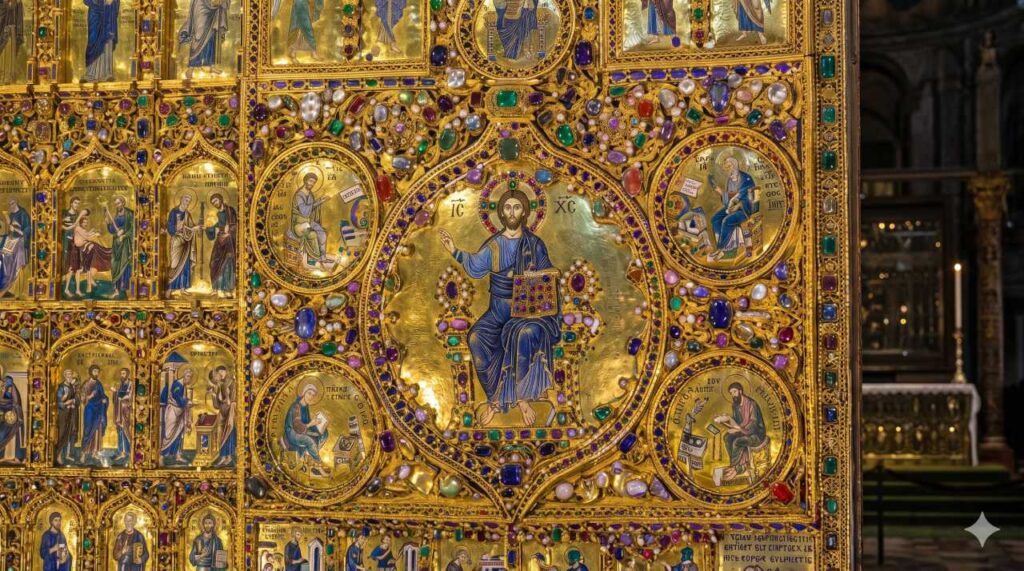
The larger, lower portion of the altarpiece presents an intricate hierarchical vision of the celestial court. At its absolute center sits Christ Pantocrator (the Almighty or All-Powerful), enthroned and blessing the world, surrounded by four smaller circular medallions depicting the four Evangelists: Matthew, Mark, Luke, and John.
Directly below Christ is a representation of the Virgin Mary, flanked by historical political and religious figures. Radiating outward from this central core are rows of neatly arranged arched compartments containing enamels of:
Framing these larger theological portraits are small, rectangular narrative plaques detailing the life, miracles, and martyrdom of Saint Mark the Evangelist, the patron saint of Venice whose relics lie directly beneath the high altar in front of the Pala.
The History of the Pala d’Oro
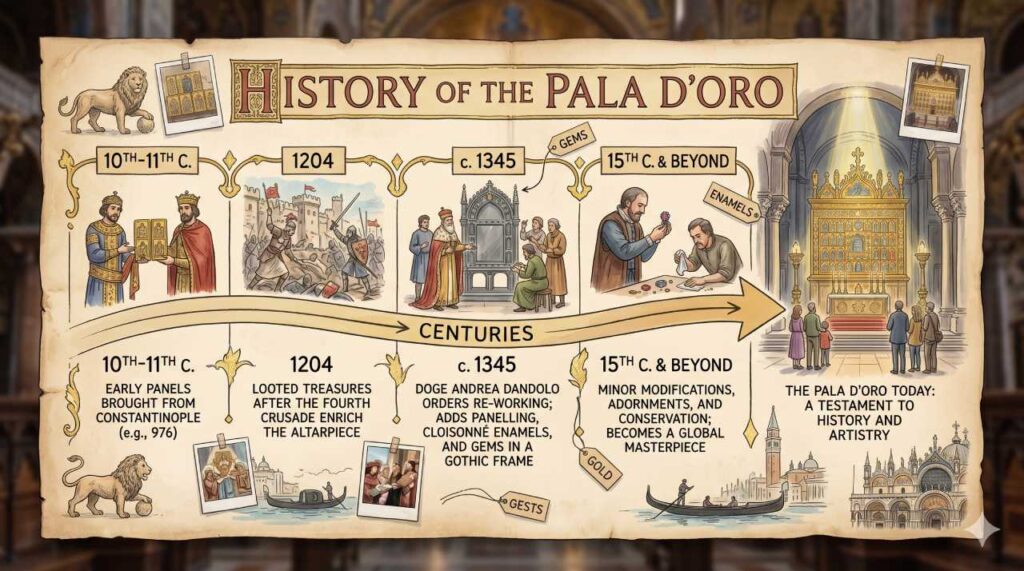
The creation of the Pala d’Oro was not a single historical event, but rather an evolutionary process spanning more than three and a half centuries. Its timeline reflects the shifting fortunes, growing wealth, and evolving aesthetic preferences of the Venetian Republic.
The First Commission by Doge Pietro I Orseolo – 976 AD

Following a devastating fire that destroyed parts of the Ducal Palace and the original Basilica of St. Mark, Doge Pietro I Orseolo ordered a modest, initial golden altarpiece from artisan workshops in Constantinople. This early version was likely a simple, flat screen decorated with enamels, meant to honor the newly rebuilt shrine of Saint Mark.
The Expansion under Doge Ordelafo Falier – 1105 AD
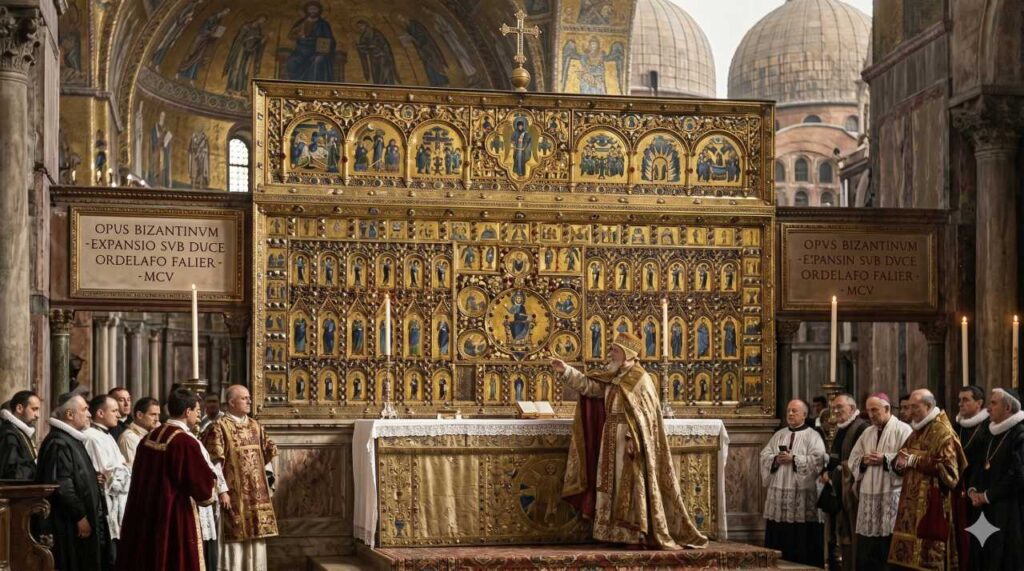
Seeking a far grander statement of Venetian prestige, Doge Ordelafo Falier commissioned a major enlargement of the altarpiece. New enamel panels were ordered from Constantinople, including portraits of the Doge himself and the Byzantine Empress Irene. This phase transformed the object into a significant, multi-paneled display of political and spiritual alignment.
The Influx of Byzantine Plunder – 1204 AD
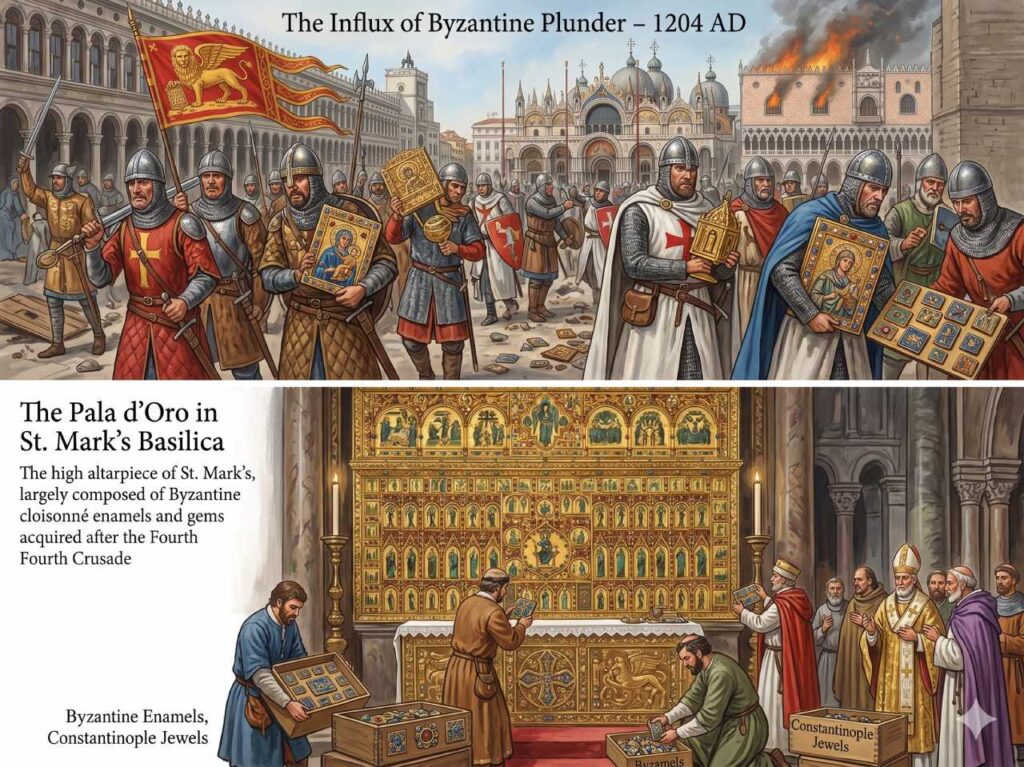
During the infamous Fourth Crusade, Venetian forces led by Doge Enrico Dandolo sacked Constantinople, the capital of the Byzantine Empire. Vast quantities of gold, silver, relics, and artworks were shipped back to Venice. Among these spoils were precious enamels and gemstones that were systematically incorporated into the fabric of the Pala d’Oro.
The Gothic Reconstruction by Paolo Veneziano – 1343 AD
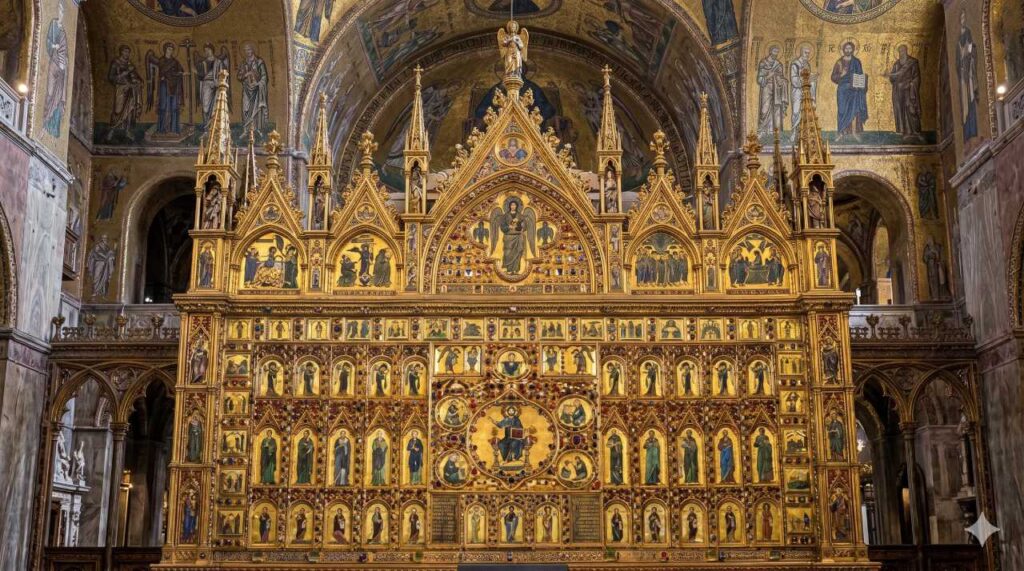
Doge Andrea Dandolo commissioned the definitive, final reconstruction of the altarpiece. He hired the prominent Venetian master goldsmith Gianpaolo Boninsegna to rework the entire metallic framework into a contemporary Late Gothic style, characterized by pointed arches, delicate spires, and intricate filigree. Concurrently, the famous painter Paolo Veneziano was hired to create a wooden cover (pala feriale) to protect the masterpiece during standard weekdays.
The 1343 configuration is precisely what visitors see when they stand in St. Mark’s Basilica today. It represents a unique artistic fusion: Byzantine Roman icons enclosed tightly within a structural cage of Venetian Gothic goldwork.
Why is the Pala d’Oro So Famous?
The worldwide renown of the Pala d’Oro stems from a combination of its sheer material extravagance, its peerless artistic quality, and its unique survival as a historical artifact.
1. The Pinacle of Cloisonné Enamelwork
Art historians consider the Pala d’Oro to be the greatest concentrated collection of Byzantine cloisonné enamel in the world.
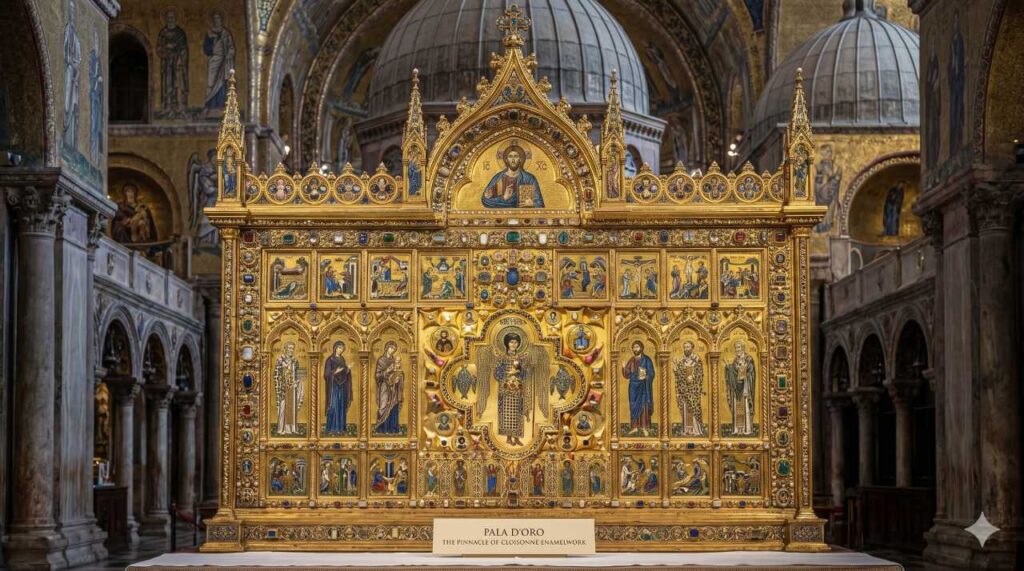
The technical expertise required to construct these panels is immense. Each color of enamel requires a different firing temperature; a single mistake in the kiln could crack the glass paste or melt the delicate gold partitions, destroying weeks of intricate craftsmanship. The survival of over 250 individual enamel plaques in a single monument offers an unparalleled library of medieval artistic techniques.
2. An Astonishing Accumulation of Precious Stones
Beyond the gold framework and the colorful enamels, the altarpiece is a literal treasure chest of gemstones. The surface is encrusted with thousands of jewels that catch the ambient light of the basilica.
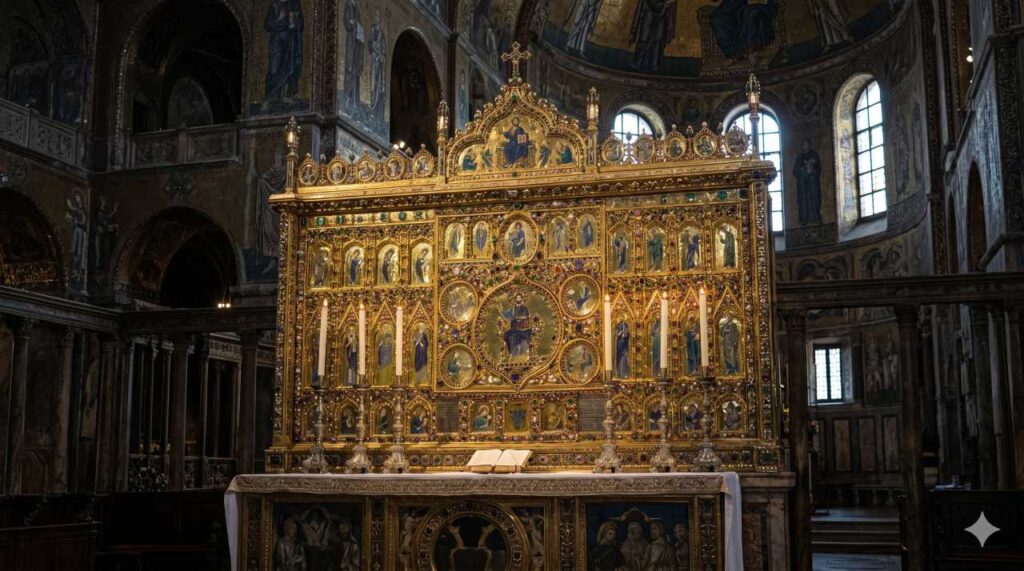
The sheer volume of material wealth fixed to a single object is staggering, reflecting the immense trade revenues flowing through the Venetian maritime empire at its peak.
3. A Mirror of Medieval Geopolitics
The Pala d’Oro tells a profound political story about the relationship between Venice and Constantinople. The inclusion of political portraits within a religious altarpiece was a bold statement.
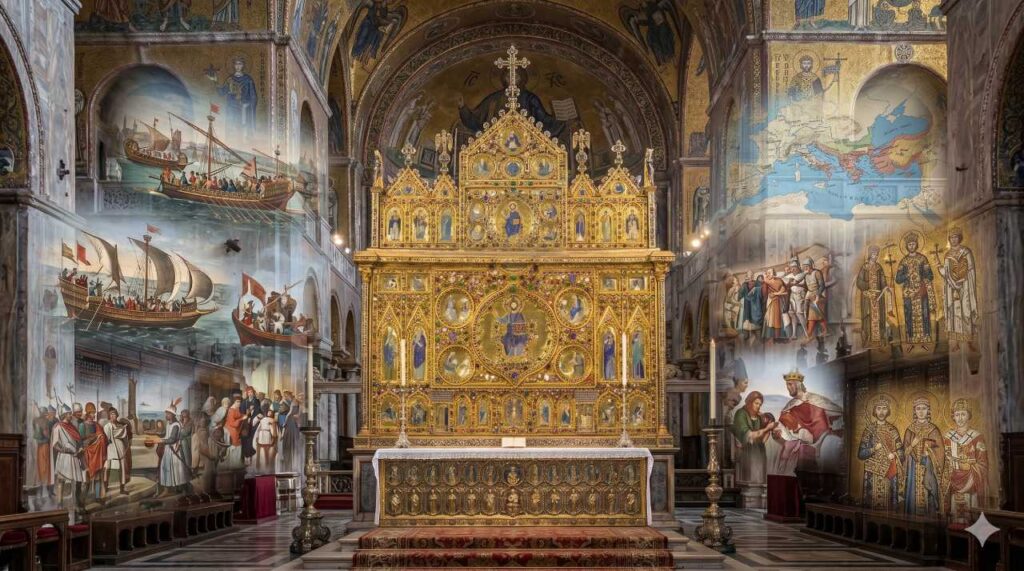
In one notable historical detail, the enamel portrait of Doge Ordelafo Falier was altered over time: the head of the Doge was retrofitted onto what was originally a portrait of a Byzantine Emperor, or at the very least modified so that the halo or crown status matched or rivaled Byzantine royalty. It stands as a physical manifestation of Venice’s transition from a subservient province of the Eastern Roman Empire to its conquering successor.
How Big is the Pala d’Oro?
The physical scale of the Pala d’Oro is surprising to many visitors, as its intricate detailing often makes it appear more like a delicate piece of jewelry than a monumental architectural element. However, when viewed in person behind the altar, its true dimensions become apparent.
| Attribute | Dimension / Count |
|---|---|
| Width | 3.34 meters (approx. 11 feet) |
| Height | 2.12 meters (approx. 7 feet) |
| Total Enamel Plaques | 250+ individual panels |
| Pearls | ~1,300 |
| Emeralds | ~400 |
| Sapphires | ~300 |
| Rubies | ~90 |
In addition to these core gemstones, the altarpiece is adorned with hundreds of amethysts, topazes, jaspers, and agates. The entire composition weighs hundreds of pounds, requiring a sturdy, integrated stone and metal structural support network built directly into the back of the high altar platform.
Is it Worth Visiting the Pala d’Oro?
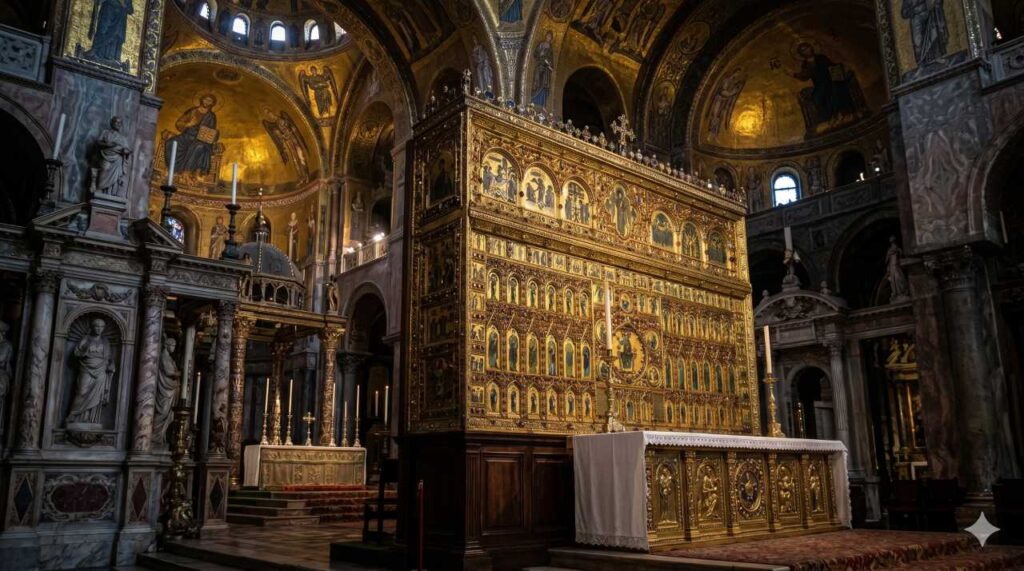
When planning an itinerary through Venice, time management is critical. St. Mark’s Basilica is filled with extraordinary sights—from the thousands of square feet of shimmering ceiling mosaics to the historic marble floors. Amid all this visual stimulation, visitors must decide whether to make the specific detour behind the high altar to view the Pala d’Oro up close.
Why You Should Visit
Viewing the Pala d’Oro is highly recommended for anyone with an interest in art history, medieval craftsmanship, or Venetian heritage.
Exploring the Iconography: A Closer Look
To fully appreciate the altarpiece during a visit, it helps to understand the specific theological narratives depicted across its surface. The arrangement is not random; it follows a precise spatial hierarchy designed to instruct the faithful and honor the divine.
The Central Core: Christ Pantocrator
When your eyes rest upon the center of the lower section, you are looking at the traditional Byzantine representation of Christ as the cosmic judge and ruler. He holds a book of Gospels in his left hand, inlaid with enamel jewels, while his right hand is raised in a gesture of blessing. The deep blue of his robes signifies his divine nature, while the surrounding symbols of the Evangelists reinforce the global spread of his teachings.
The Historical Portraits
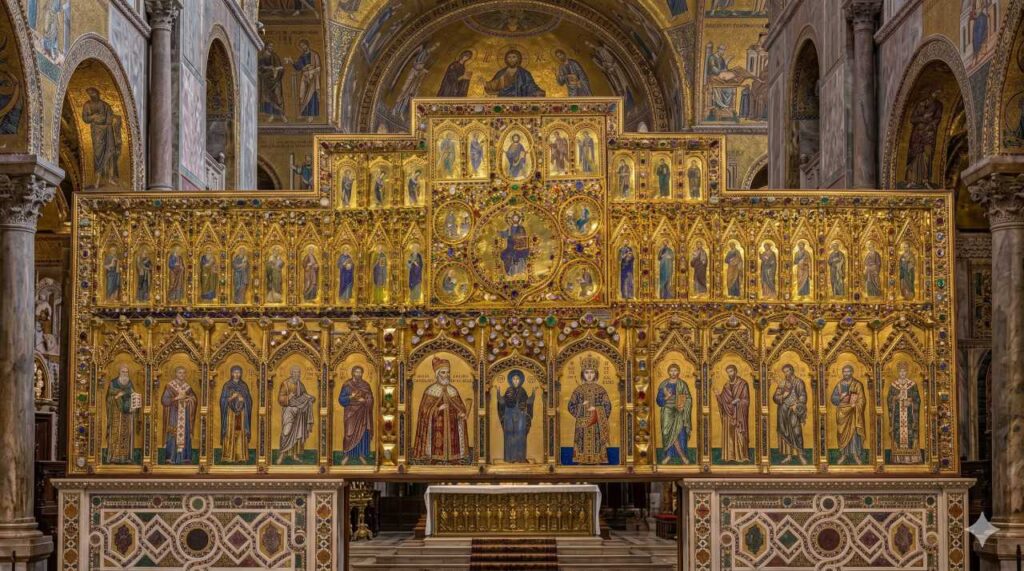
Among the rows of saints and theologians are specific historical portraits that bridge the gap between heaven and earth. Look closely at the panels flanking the Virgin Mary at the base of the central pillar:
The St. Mark Narrative Cycle
Running along the outermost vertical and horizontal borders of the lower section is a series of small, comic-strip-like panels. These tell the legendary story of Saint Mark, which was fundamental to the civic identity of Venice:
By studying these border panels, visitors can see how the Venetians seamlessly interwove their own civic mythology with the grand narrative of Christian salvation history.
Preservation and Conservation
The fact that the Pala d’Oro retains its brilliant luster is a testament to centuries of careful maintenance. The environment inside St. Mark’s Basilica is challenging; proximity to the Venetian lagoon means the air carries high levels of humidity and salt, which can accelerate the tarnish and corrosion of silver and gold alloys.
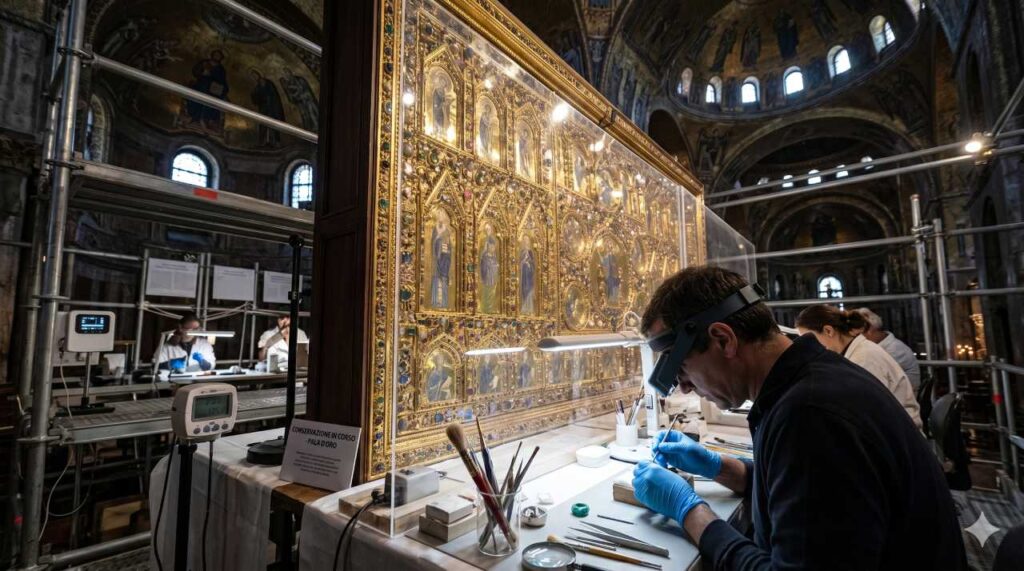
Throughout its history, the altarpiece has undergone several major cleanings and restorations:
The Pala d’Oro stands as a monument to an era when art, faith, and political power were forged into a single, glittering object. It remains a definitive highlight of Venetian craftsmanship and a must-see anchor point for anyone exploring the historic heart of the Republic of St. Mark.
1. What does “Pala d’Oro” actually mean?
The name translates literally from Italian as “Golden Cloth” or “Golden Altarpiece” (derived from the Latin palla, meaning a cloth or shroud). It refers to the massive screen of gold, silver, and jewels positioned directly behind the high altar of St. Mark’s Basilica.
2. Is the Pala d’Oro made of solid gold?
No, it is not solid gold, which would be too soft and heavy to support itself. Instead, it consists of a sturdy core structure layered with sheets of pure gold and silver-gilt (silver covered with a chemically bonded layer of gold). This serves as the metallic canvas for its hundreds of enamel plaques and thousands of jewels.
3. How many gems are embedded in the altarpiece?
The Pala d’Oro is encrusted with nearly 2,500 individual precious stones and pearls. A precise inventory of the gemstones includes:
4. Where did all the gold and jewels come from?
The materials came from two primary sources: expensive state commissions and military plunder. While early versions were bought legally from Constantinople, a massive influx of the enamels and gems visible today arrived after the Fourth Crusade in 1204, when Venetian forces systematically looted the churches, palaces, and imperial treasuries of the Byzantine capital.
5. Why are some figures in the altarpiece missing their heads or altered?
The altarpiece was pieced together over 350 years, leading to some fascinating historical “copy-pasting.” For instance, the enamel portrait of the Venetian ruler Doge Ordelafo Falier was actually modified by medieval goldsmiths. They cut the head off an existing Byzantine imperial portrait and retrofitted a new head onto it so the Doge could claim equal visual status with Eastern emperors.
6. What technique was used to make the colorful images?
The images are created using cloisonné enamelwork, a hallmark of Byzantine art.
Artisans soldered incredibly thin strips of gold wire onto a gold base plate to outline a design (creating small cells or cloisons). They then filled these tiny cells with powdered glass paste of various colors and fired the plate in a kiln, melting the glass into a vibrant, permanent glaze.
7. What stories do the small borders tell?
While the center of the altarpiece focuses on Christ, the outer borders tell the dramatic, episodic story of Saint Mark the Evangelist, the patron saint of Venice. It illustrates his life, his martyrdom in Egypt, and the famous 828 AD operation where two Venetian merchants stole his relics from Alexandria, hid them under a shipment of pork to trick Muslim customs officials, and brought them triumphantly to Venice.
8. Was the Pala d’Oro always on display?
No. For most of Venice’s history, the Pala d’Oro was considered too sacred and valuable to leave exposed to daily crowds and candle soot. It was kept hidden behind a painted wooden cover known as a pala feriale (weekday altarpiece), painted by the master artist Paolo Veneziano. It was mechanically unveiled only during major liturgical feasts like Easter, Christmas, and the Feast of St. Mark.
9. How did it survive Napoleon’s invasion of Venice?
When Napoleon conquered the Venetian Republic in 1797, his troops stripped, melted down, and looted almost all of the city’s gold and silver treasuries. The Pala d’Oro survived because it was physically integrated into the high altar as a fixed architectural element, making it far more difficult to dismantle and carry away than loose treasury chalices or reliquaries.
10. Can you see it clearly from the main floor of the Basilica?
Not clearly. Because the Pala d’Oro sits deep behind the high altar and faces away from the main congregation area (it faces the apse behind the altar), you can only see a distant, reverse profile from the public nave. To truly appreciate the scale, the glitter of the gems, and the expressions on the enamel faces, you must walk along the dedicated visitor pathway that loops directly behind the altar.