
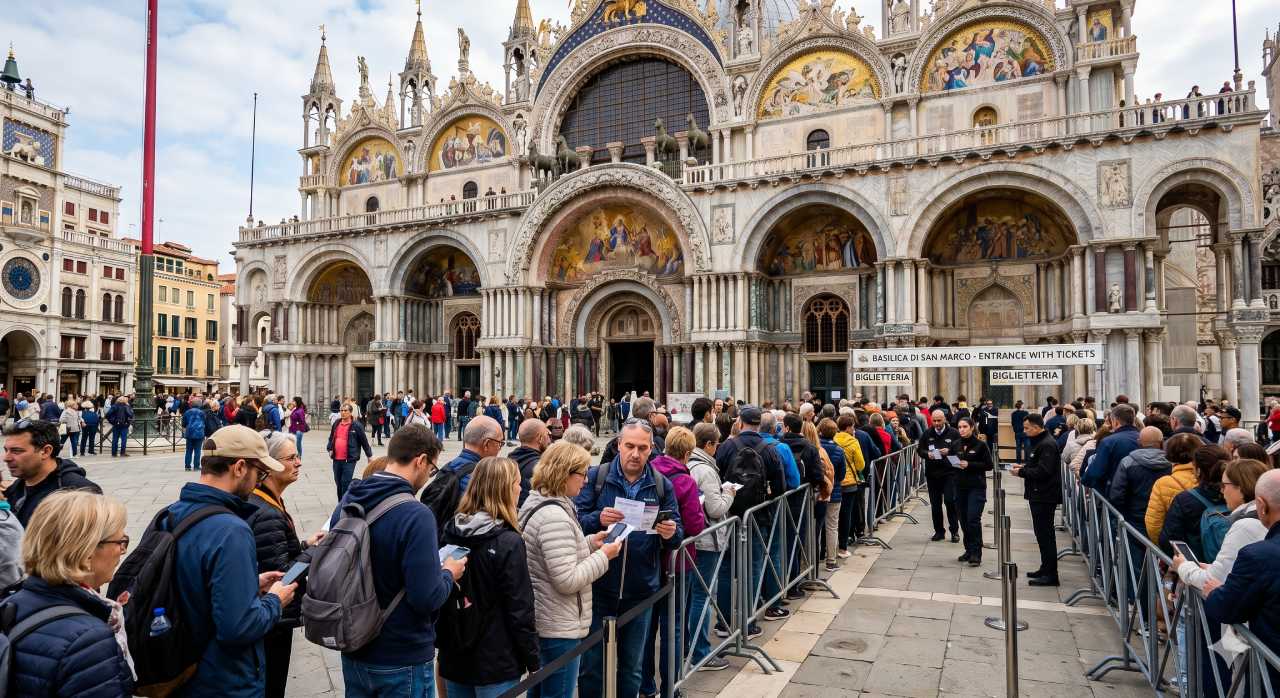
Visiting St. Mark’s Basilica (Basilica di San Marco) is a profound encounter with Byzantine luxury, Venetian political history, and medieval artistry. However, navigating this ancient structure requires a solid understanding of current regulations, ticketing structures, and local crowd patterns.
To help you maximize your time and avoid common mistakes, this comprehensive guide covers 20 practical and up-to-date tips for your visit.
1. Ditch the “Free Entry” Myth and Pre-Book Online
For decades, budget travelers relied on the fact that entering St. Mark’s Basilica was entirely free. This is no longer the case. To manage the immense flow of tourism and protect the fragile marble interiors, the basilica uses a strictly regulated ticketing system.
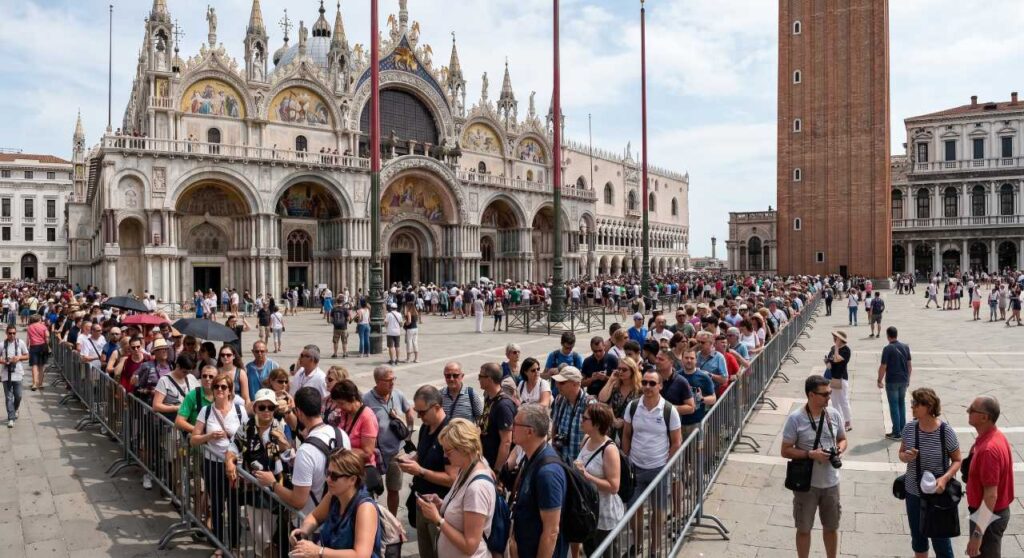
While a tiny fraction of tickets are held for walk-ups at the door, the queues for these are notoriously long, often stretching across the sun-baked stones of the piazza for over an hour. Booking your timed-entry slot online well in advance via the official portal is essential. A basic entry ticket costs around €10 online, which secures your specific 15-minute arrival window and bypasses the main ticket-purchase line.
2. Decode the Modular Ticket Structure Before Buying
When purchasing tickets, it is easy to assume that a standard entry pass grants access to the entire complex. Instead, St. Mark’s operates on a modular ticket format. The baseline ticket only grants access to the main floor area and central nave.
If you wish to view the dazzling Pala d’Oro (the golden altarpiece behind the main altar) or head upstairs to the Museo di San Marco and the famous outdoor terrace (Loggia dei Cavalli), you must pay supplementary fees. You can bundle these options into a single comprehensive pass online (typically around €30) or purchase add-on tickets inside the church using cash or credit card. Booking the all-inclusive bundle upfront saves time and prevents you from standing in secondary queues inside the basilica.
3. Plan Your Visit Around the Golden Illumination Hour
The interior of St. Mark’s is famously dark. To protect the delicate structural elements and ancient art, the interior windows are small, and the spaces can feel dimly lit. However, every weekday between 11:30 AM and 12:30 PM, the church turns on its internal lighting system.
During this brief window, thousands of square meters of 24-karat gold-leaf mosaics are completely illuminated. The dull, dark ceiling transforms into a shimmering, celestial canopy. If you can secure an online time slot that places you inside the church during this hour, your visual experience will be vastly superior to any other time of day.
4. Book a Night Tour for an Exclusive, Crowdfree Experience
If your budget allows, booking an after-hours night tour is one of the most rewarding insider investments you can make in Venice. Once the basilica closes to the general public in the late afternoon, a limited number of specialized tour groups are granted exclusive entry.
During these evening tours, the church is completely dark until the guide turns on the lights specifically for your small group. You can stand in the absolute silence of the nave without thousands of whispering tourists around you, getting a rare view of the crypts and main altars that are usually cordoned off during the day.
5. Master the Strict Bag Policy and Locate the Free Depot
Security at St. Mark’s Basilica is highly stringent. No large bags, backpacks, suitcases, or bulky shoulder bags are permitted inside. Even medium-sized daypacks that you might normally take into a museum will be rejected at the security checkpoint.
If you show up to the front gate with a forbidden bag, guards will turn you away, causing you to lose your timed entry slot. To avoid this, head directly to the Ateneo San Basso, located in a small alleyway (Piazzetta dei Leoncini) just to the north of the basilica’s main facade. Here, you can check your luggage and backpacks for free before joining the security line. Keep your valuables, wallet, and phone with you, as you will only drop off the bags themselves.
6. Dress with Strict Modesty to Avoid Being Rejected at the Door
Because St. Mark’s is an active house of worship and a consecrated Catholic cathedral, the dress code is non-negotiable. Security staff will turn away visitors who do not comply, regardless of whether they hold an expensive pre-booked ticket.
If you are traveling during hot summer months, carry a lightweight linen scarf, shawl, or sarong in your small pocket. You can quickly wrap it around your shoulders or waist before reaching the front doors.
7. Budget Up to €7 Extra for the Museum and Terrace Access
While the ground floor offers a stunning look at the main structure, paying the extra €7 fee to head upstairs to the Museo di San Marco and the Loggia dei Cavalli is highly recommended. The steep stone staircase brings you to an elevated vantage point that provides a much closer look at the vault mosaics.
Furthermore, this ticket grants access to the open-air roof terrace. This exterior balcony offers an expansive view of Piazza San Marco, the Campanile, and the Venetian Lagoon. It is also the only place where you can stand alongside the monumental bronze horses overlooking the square.
8. Meet the Horses: Admire the Originals Inside, Replicas Outside
When you look up at the front facade of the basilica from the square, you will see four grand bronze horses leaping out over the central arch. These horses possess an extraordinary provenance: they were plundered from the Hippodrome of Constantinople during the Fourth Crusade in 1204.
However, the horses on the exterior facade are high-quality replicas. The harsh, salty, and polluted air of the Venetian lagoon began degrading the ancient bronze over a century ago. To see the true, original Roman masterpieces, you must purchase admission to the upstairs museum, where the actual ancient statues are safely preserved in a climate-controlled room.
9. Wear Non-Slip, Flat Shoes for the Rolling Marble Floors
The floor of St. Mark’s Basilica is an absolute masterpiece of medieval stonework, featuring intricate geometric and zoomorphic designs made of porphyry, jasper, and marble fragments. However, you will notice immediately that the floor is entirely uneven, rolling up and down like gentle waves.
Centuries of heavy foot traffic, coupled with the shifting, muddy foundations of the artificial wooden piles beneath the church, have caused the floor to warp and sink in sections. Combined with the smooth sheen of old marble, the walking surface can be slick and uneven. Avoid high heels, flip-flops, or smooth-soled shoes; opt instead for sturdy, flat walking shoes with good grip.
10. Pay the Additional Surcharge to Face the Magnificent Pala d’Oro
Located directly behind the high altar, where the relics of St. Mark the Evangelist rest, sits the Pala d’Oro. This universal masterpiece of Byzantine craftsmanship is an altar screen constructed from sheets of gold, silver filigree, and cloisonné enamel work.
It is embedded with nearly 2,000 precious gems, including emeralds, sapphires, rubies, and pearls. To view it closely, you must walk around to the back of the altar and pay a separate entry fee of approximately €5 (if not already included in your bundle ticket). The detail of the enamelwork is stunning, and it offers an excellent look at the artistic pillaging that defined Venice’s golden age.
11. Use the Hidden “Porta dei Fiori” if You Wish to Pray
If your primary goal in visiting St. Mark’s is religious worship, personal prayer, or attending a scheduled Catholic Mass, you do not need to buy a tourist ticket or stand in the main sightseeing queue.
Instead, look for the Porta dei Fiori (The Gate of Flowers), which is located on the north side of the basilica facing the Piazzetta dei Leoncini. This entrance is exclusively reserved for worshippers, local parishioners, and those attending services. Security guards will allow you inside for free, but you will be directed straight to a cordoned-off chapel dedicated to private prayer, away from the main tourist walking paths.
12. Be Prepared for the Lightning-Fast 10-Minute Limit in High Season
During peak travel seasons (May through October), the sheer volume of visitors means that the basilica staff must enforce strict traffic management policies on the ground floor. In these busy periods, your path through the main nave is highly directed along a one-way wooden walkway.
Signs and audio announcements often remind visitors that the basic ground-floor tour is meant to take roughly 10 to 15 minutes. To make the most of this rapid walkthrough, keep your head up and study the mosaics as you walk, rather than looking down at your phone. If you wish to linger longer and move at your own pace, buying the museum ticket to head upstairs is your best option, as the upper level does not have a strict time constraint.
13. Skip the Commercial Apps and Download the Official Audio Guide
Many third-party tour companies sell overpriced audio guides or clunky smartphone apps that are poorly synchronized with the actual layout of the church. For an optimal self-guided experience, use the official digital audio guide app offered directly by the basilica’s conservation authority.
You can download it using the official QR codes at the entryway or pre-purchase it with your online ticket package. Be sure to bring a pair of personal wired or wireless headphones with you, as playing audio out loud through your phone speaker is strictly prohibited out of respect for the sacred environment.
14. Keep Your Camera Discretely Positioned and Turn Off the Flash
Historically, photography of any kind was strictly forbidden inside the basilica. While the rules have softened slightly to allow for casual smartphone photos of the architecture, flash photography and video recording remain completely banned.
Using a bright flash will immediately draw the attention of the church docents, who will loudly reprimand you or ask you to leave. Furthermore, heavy tripods, monopods, and selfie sticks are prohibited at the security screening. Keep your phone or camera close to your chest, turn off your flash and camera sounds, and take quick, respectful shots without blocking the flow of the walking path.
15. Check the Weather Forecast and Know the Reality of Acqua Alta
Because of its location at the lowest geographical point in Venice, Piazza San Marco is the very first area of the city to flood during Acqua Alta (high tide events). While the city’s state-of-the-art MOSE barrier system now protects Venice from catastrophic high tides, smaller tidal swells still cause water to bubble up through the square’s drainage system.
Recently, glass barriers were installed around the base of the basilica to keep the immediate narthex dry, but severe weather can still disrupt operations or cause temporary closures. Check local Venetian tide apps (such as hi!tide Venice) before your visit. If a high tide is expected, the square can become submerged, requiring you to use the elevated wooden walkways (passerelle) to reach the church doors.
16. Combine Your Visit Sequentially with the Doge’s Palace
Architecturally and historically, St. Mark’s Basilica and the Doge’s Palace (Palazzo Ducale) are fundamentally linked. For centuries, the basilica served not as the public cathedral of Venice, but as the Doge’s private state chapel. The two buildings stand right next to each other and are even connected by hidden interior corridors used by the rulers of Venice.
To save time and minimize backtracking across the city, schedule your visits to these two monuments back-to-back. Many booking platforms offer convenient combo tickets that grant priority access to both sites on the same morning or afternoon, providing a cohesive narrative of Venice’s political and spiritual history.
17. Climb the Campanile Immediately After for the Perfect Complement
The Campanile di San Marco (the massive red-brick bell tower standing independently in the square) offers an entirely different perspective on the basilica. Climbing or riding the elevator to the top of the tower right after your basilica tour provides an incredible bird’s-eye view of the church’s unique architecture.
From the top of the Campanile, you can look down onto the basilica’s five massive Byzantine domes, which are covered in lead sheathing, and see how the structure integrates into the wider palace complex. Like the basilica, the Campanile requires its own timed-entry ticket, so try to book your tower slot for roughly 60 to 90 minutes after your basilica entry time.
18. Walk a Few Blocks Away for Dining to Avoid the “Piazza Tax”
After a long morning of exploring the basilica and standing on marble floors, you will undoubtedly be ready for a cup of Italian espresso, a glass of Venetian Spritz, or a light lunch. However, sit-down dining at any of the historic cafes directly on the perimeter of Piazza San Marco comes with an immense premium.
At famous spots like Caffè Florian or Gran Caffè Quadri, a single coffee can cost upwards of €10–€15 if you sit outside to listen to the live orchestras. If you are on a budget, walk just two or three blocks away into the winding alleys of the Castello or San Marco districts. Here, you will find authentic local bavari (bars) and osterie where you can enjoy local cicchetti (Venetian tapas) and drinks at standard Italian prices.
19. Do Not Feed the Pigeons in the Square Prior to Entry
While waiting for your scheduled entry slot to open, you will likely spend time hanging around Piazza San Marco. The square was once famous for its vast swarms of pigeons, and vendors used to sell grain to tourists looking for photos with the birds.
Today, feeding the pigeons anywhere in the square is completely illegal and carries steep fines of up to €200. The birds’ acidic droppings cause immense chemical damage to the delicate marble carvings and stone mosaics on the exterior of the basilica. Keep all food items sealed in your bag while waiting in the piazza, and avoid attracting the birds to the area.
20. Study the Narthex Mosaics First Before Rushing Inside
When you finally pass through security and enter the church, you will find yourself in the narthex, or the covered entry vestibule. Many tourists are so eager to see the grand main nave that they rush right through this area without looking up.
This is a major mistake. The mosaics in the ceiling of the narthex are among the oldest and most detailed in the entire building, depicting vivid, graphic stories from the Old Testament, including the Creation, Noah’s Ark, and the Tower of Babel. Spend a few minutes studying these panels before passing through the inner doors; they serve as the literal and thematic prologue to the grand visual narrative waiting inside the main church.