
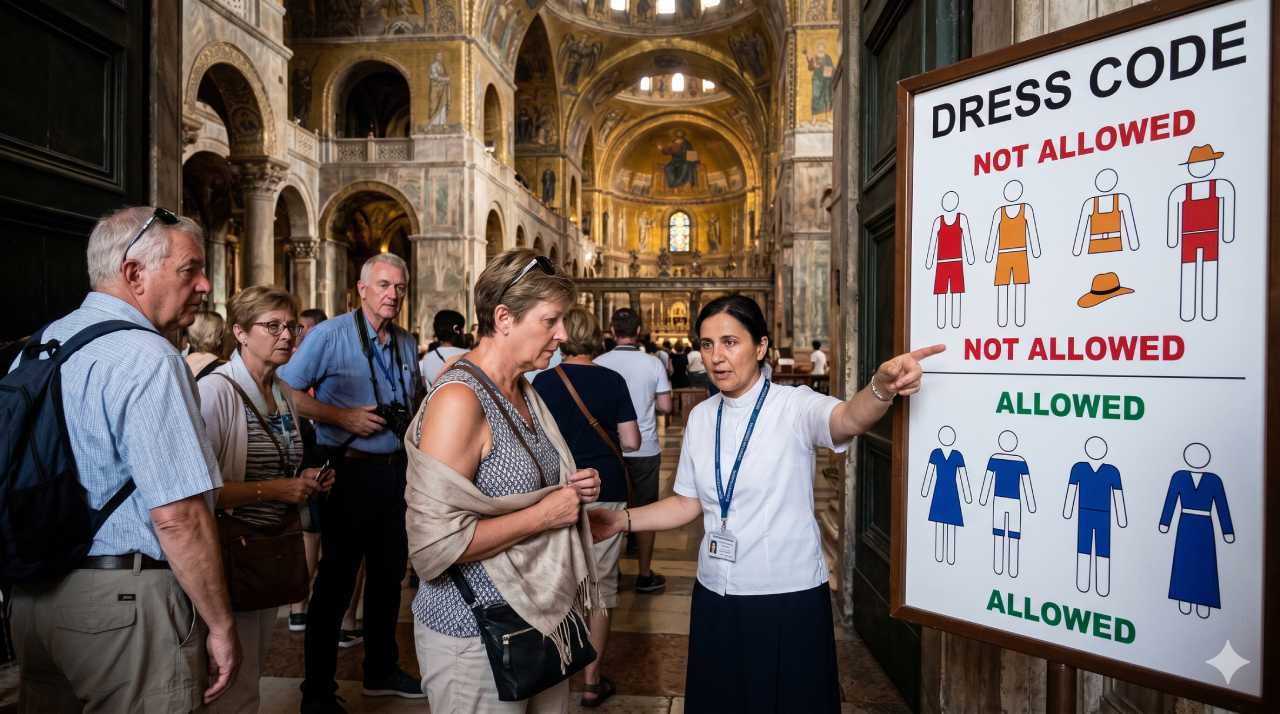
Venice is a city woven from water, light, and history, but its spiritual and architectural heart resides indisputably within the golden walls of St. Mark’s Basilica (Basilica di San Marco). As one of the most magnificent examples of Italo-Byzantine architecture in the world, the cathedral attracts millions of global travelers annually. They come to marvel at the 85,000 square feet of luminous gold mosaics, gaze upon the priceless Pala d’Oro, and step through portals that have witnessed the rise and fall of empires.
However, because St. Mark’s is a triumph of art history, it is easy for modern visitors to forget its foundational purpose. It is not an open-air museum, nor is it merely a picturesque backdrop for photography. It is an active, consecrated Roman Catholic cathedral, a sanctuary of profound spiritual significance, and the seat of the Patriarch of Venice.
To maintain the sanctity of this holy space, the ecclesiastical authorities enforce a strict, non-negotiable dress code. Stepping from the sun-drenched, humid expanse of St. Mark’s Square into the cool, shadowed interior of the basilica requires a transition not just of geography, but of mindset. This comprehensive guide outlines the rules, rationale, and practical strategies for dressing appropriately when visiting Venice’s crowning jewel.
The Core Philosophy of the San Marco Dress Code
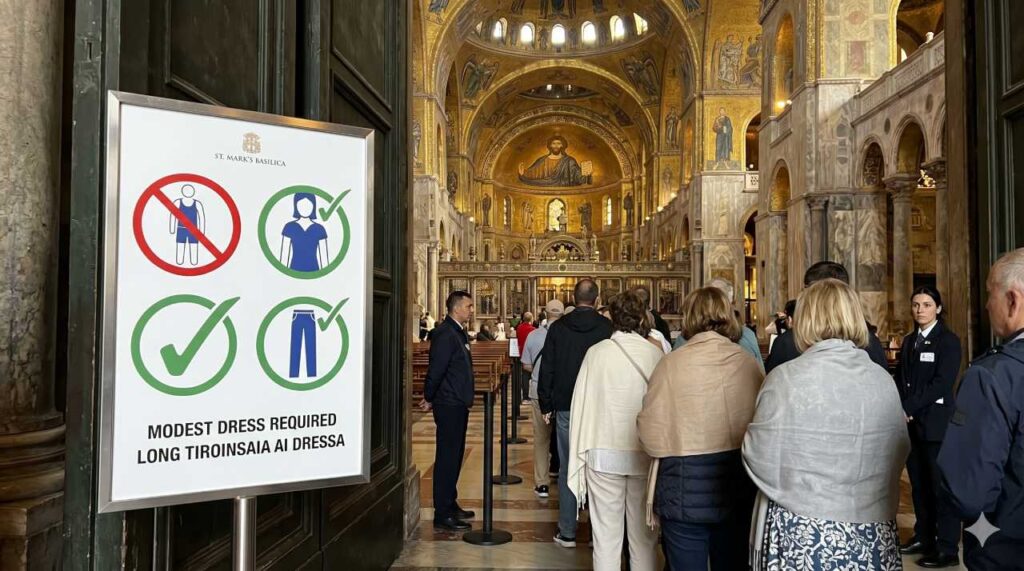
The overarching mandate for entering St. Mark’s Basilica can be summarized in two words: modest attire. The dress code is designed to ensure that all entrants show respect for the religious environment, the worshippers inside, and the centuries of sacred tradition the building represents.
Unlike secular tourist attractions, the basilica requires a standard of dress that minimizes vanity, avoids overt displays of skin, and honors the solemnity of a house of God.
The Universal Baseline
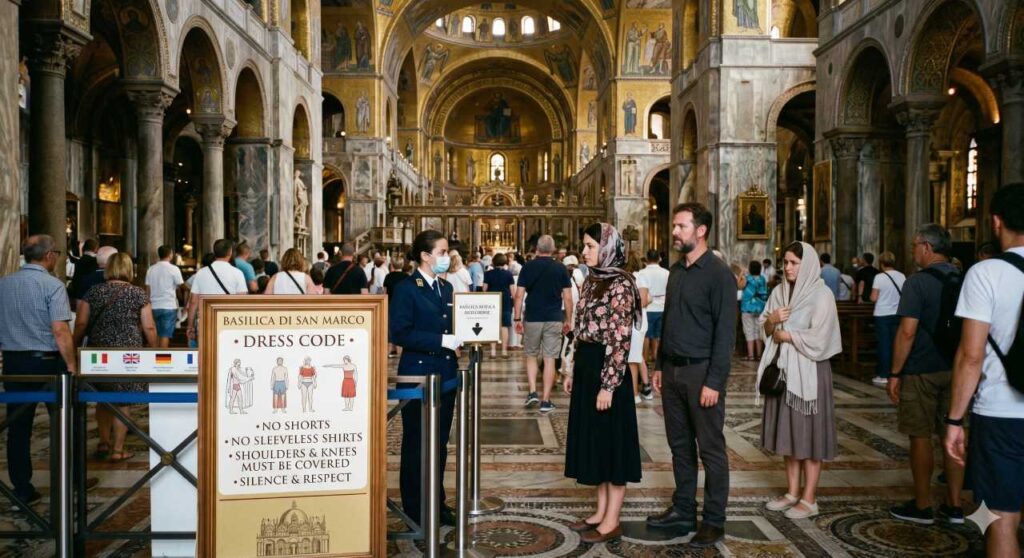
Regardless of gender or age, there are several foundational rules that apply to every single person seeking entry:
The enforcement of these rules is meticulous. Security personnel stand guard at the entrance, and they possess full discretion to turn away anyone whose attire does not meet these standards. There are no exceptions made for hot weather, long queue times, or tourist oversight. If you are not dressed appropriately, you will be denied entry, turning what should be a highlight of your Venetian journey into a frustrating disappointment.
What Women Should Wear to Enter the Cathedral
For women, navigating the dress code requires a thoughtful balance between staying comfortable in Venice’s often sultry summer climate and maintaining the required level of modesty. The key to success lies in choosing breathable, structured pieces or mastering the art of layering.
Appropriate Tops and Upper-Body Wear
When selecting a top for the basilica, the golden rule is complete shoulder and chest coverage.
Appropriate Bottoms and Lower-Body Wear
The lower half of your outfit must prioritize length and coverage. The guards watch specifically for hemlines that ride up above the kneecap.
What Men Should Wear to Enter the Cathedral
The dress code for men at St. Mark’s Basilica is often perceived as straightforward, yet it is a frequent point of failure for many male tourists, particularly regarding the length of their shorts and the style of their shirts. The expectation for men is a look that leans conservative, neat, and respectful.
Appropriate Tops
Men must eschew casual athletic wear in favor of standard casual or smart-casual shirts.
Appropriate Bottoms
The debate over shorts is the most common issue men face at the basilica gates.
Footwear, Headwear, and Accessories for All Visitors
Beyond shirts and pants, the dress code extends to what you wear on your head, your feet, and what you carry on your back.
Footwear Regulations
While the official rules focus heavily on clothing coverage, your choice of footwear matters for both respect and practical safety.
Headwear Traditions
The rules regarding hats and head coverings follow traditional Western European etiquette, splitting cleanly along gender lines:
Bags and Luggage Restrictions
For security reasons and to preserve the tight physical spaces inside the cathedral, large bags, backpacks, suitcases, and bulky items are strictly forbidden inside St. Mark’s Basilica.
Why Is There a Dress Code in the Cathedral?
To the modern traveler used to secular museums and relaxed social standards, the strict enforcement of a dress code can initially feel restrictive or archaic. However, understanding the deep historical, theological, and cultural reasons behind these rules transforms them from an inconvenience into a meaningful ritual of respect.
1. Theological Reverence and Sacramental Sanctity
At its core, St. Mark’s Basilica is a house of prayer. For Roman Catholics, a church is not merely a meeting space; it is the literal dwelling place of Christ through the Real Presence in the Eucharist, kept within the tabernacle.
Therefore, entering the basilica is viewed as entering into the presence of the Divine. Modest dress is an external reflection of internal humility. By covering the body, visitors shift the focus away from the individual, physical self and redirect it toward spiritual contemplation and reverence for God.
2. Respect for the Living Community of Faith
While thousands of tourists walk through the nave to admire the art, local Venetians and pilgrims come to St. Mark’s to confess, pray, weep, and celebrate Mass.
Intrusive, overly casual, or revealing clothing shatters the solemn atmosphere required for deep prayer. Dressing respectfully ensures that the basilica remains a functional sanctuary for the living community of faith, rather than being entirely subsumed by tourism.
3. Preservation of Historical and Cultural Heritage
Venice’s identity is inextricably bound to St. Mark’s. Historically, the basilica was the private chapel of the Doge (the ruler of the Venetian Republic) and a symbol of Venice’s wealth, political might, and divine protection. The art inside tells the story of Venetian triumph, Eastern influence, and state piety.
When you dress appropriately, you honor the cultural heritage of Venice itself. You acknowledge that you are a guest in a space built by centuries of artisans, statesmen, and believers who poured their lives into creating a monument to the transcendent. Adhering to the dress code is an act of cultural citizenship—a way of saying that you value the traditions of the host city.
Practical Strategies for the Savvy Traveler
Knowing the rules is one thing; executing them seamlessly during a hectic day of sightseeing in Venice is another. Here are highly practical strategies to ensure you pass through security without a hitch.
The Scarves and Shawls Strategy
If you are visiting Venice during the peak of summer, walking around the city in long sleeves and heavy trousers can cause overheating. The most effective solution is the “San Marco Emergency Scarf.”
Buy a Disposable Cover-Up as a Last Resort
If you forget a scarf or arrive unprepared, do not panic. While the basilica no longer hands out free fabric cover-ups due to sustainability and crowd control, local vendors and nearby shops sell inexpensive, lightweight disposable cover-ups or paper shawls specifically designed for tourists caught off guard. However, buying these adds unnecessary expense and plastic waste to the environment, so planning your outfit ahead of time is always the superior option.
Plan the Sequence of Your Day
Because of the bag restrictions and dress code requirements, it pays to structure your Venetian itinerary intentionally:
Conclusion: A Small Gesture of Mutual Respect
The dress code of St. Mark’s Basilica should not be viewed as an arbitrary barrier to entry, but rather as an invitation to participate in the preservation of a sacred masterpiece. By taking a few intentional moments to select appropriate clothing, cover your shoulders, and ensure your hemlines reach your knees, you honor the millions of believers who have sought solace within these walls over the past millennium.
In a world that increasingly favors convenience and casualness, stepping into the golden light of San Marco cloaked in modest, respectful attire is a beautiful nod to the timelessness of Venetian history and the enduring power of sacred spaces.
1. What happens if I arrive at St. Mark’s Basilica wearing shorts or a sleeveless top?
If you reach the front of the security line in clothing that exposes your shoulders, chest, or knees, the security guards will deny you entry immediately. You will lose your place in line and will not be permitted to enter until you have changed or covered up.
2. Can women wear leggings or tight yoga pants inside the cathedral?
Leggings, skin-tight yoga pants, and athletic tights are generally discouraged because they are considered overly casual gym wear. However, you will usually be allowed entry if your upper body is properly covered and you wear a long tunic, dress, or oversized shirt that extends down past your hips and upper thighs.
3. Are men allowed to wear shorts if they extend past the knee?
Yes. Men can wear shorts, but they must be tailored, conservative styles (like chino or Bermuda shorts) that clearly cover the kneecap when standing. Casual athletic shorts, board shorts, or swim trunks are strictly prohibited, even if they meet the length requirement.
4. Does the cathedral provide free shawls or cover-ups at the door?
No. To manage immense crowd sizes and reduce waste, St. Mark’s Basilica no longer provides free disposable cover-ups or rented shawls at the gates. Visitors are entirely responsible for bringing their own clothing modifications, though local street vendors nearby sell inexpensive paper wraps if you are caught unprepared.
5. Can I wear a tank top or sundress if I cover my shoulders with a transparent or sheer scarf?
No. The purpose of the dress code is modesty, so sheer, see-through, or fishnet fabrics do not count as adequate coverage. Any scarf, shawl, or pashmina used to cover bare shoulders or chest areas must be completely opaque.
6. Are open-toed shoes, sandals, or flip-flops permitted?
Standard sandals and open-toed shoes are permitted, provided they look neat. Flip-flops and beach slides are highly discouraged because they lack decorum and offer poor traction on the basilica’s uneven, centuries-old mosaic floors. High heels should also be avoided as they can damage the historic marble and pose a tripping hazard.
7. Do children have to follow the exact same dress code?
Young children and toddlers are granted a bit more leniency, but older children (roughly ages 6–8 and up) and teenagers are expected to adhere to the exact same standards as adults: no bare shoulders, no midriffs, and no short shorts or miniskirts.
8. Can men keep their hats on inside the basilica if they match their outfit?
No. According to Western Christian tradition, men must remove all forms of headwear—including baseball caps, fedoras, beanies, and sun hats—immediately upon entering the cathedral. Women, however, are traditionally permitted to keep fashion hats, sun hats, or religious headcoverings on inside.
9. What should I do if I am wearing a large backpack that doesn’t fit the dress code rules?
Bags and backpacks are a security issue rather than a dress code violation, but no large bags, backpacks, or luggage are allowed inside. Before joining the main entry queue, you must drop off your large bags at the Ateneo San Basso luggage deposit station, located in a side alley just off the square. Small purses and cross-body bags are allowed inside.
10. Is the dress code enforced during the winter months or just the summer?
The dress code is enforced year-round, but it is rarely an issue in autumn and winter when cooler weather naturally prompts visitors to wear pants, sweaters, coats, and jackets. The restrictions become a major point of friction during the hot, humid summer months when tourists are dressed for beach weather.