
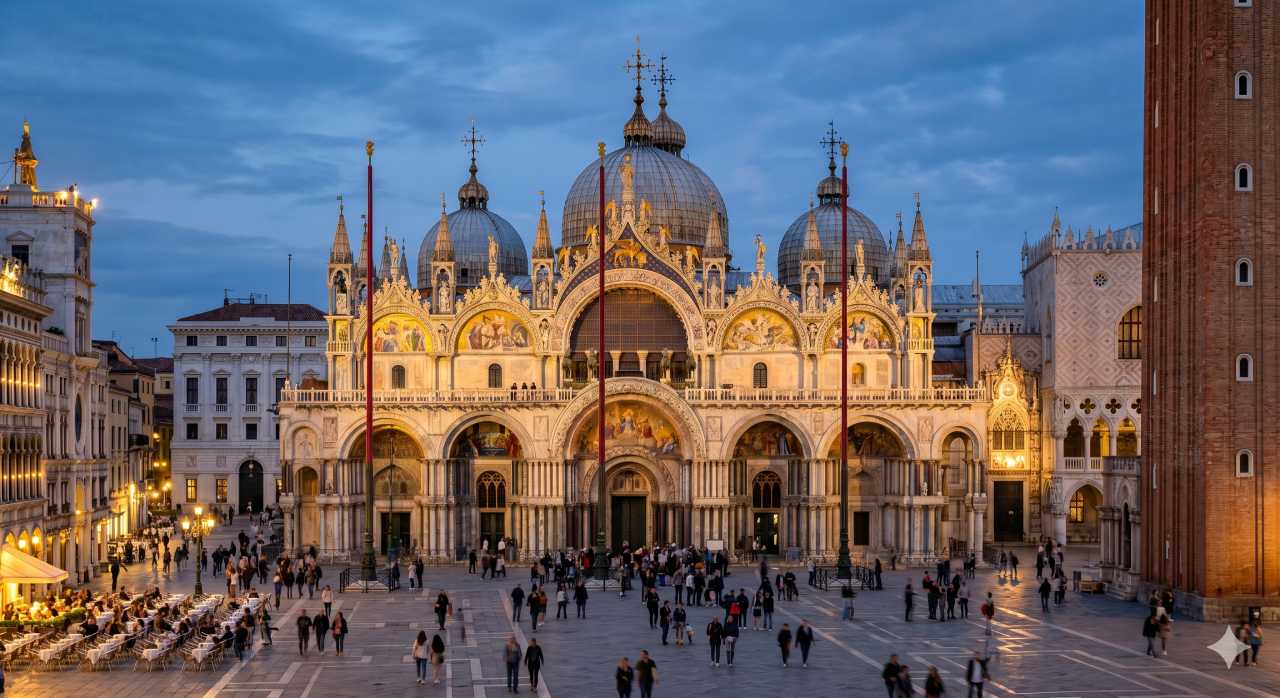
St. Mark’s Basilica (Basilica di San Marco) is the crowning jewel of Venice. With its opulent golden mosaics, blend of Eastern and Western architecture, and centuries of high-stakes history, it is as mysterious as it is beautiful.
Whether you are planning a visit or are simply fascinated by Byzantine art and Venetian history, this comprehensive guide answers the 20 most frequently asked and intriguing questions about this legendary cathedral.
1. Why is it called the “Church of Gold” (Chiesa d’Oro)?
St. Mark’s Basilica earned the nickname Chiesa d’Oro because of its unparalleled opulence, specifically its 85,000 square feet (8,000 square meters) of luminous golden mosaics that coat the interior ceilings, domes, and upper walls.
These mosaics were crafted using a meticulous technique: thin leaves of 24-karat gold were sandwiched between two layers of clear glass. Because the glass tiles (tesserae) were set at slight angles rather than perfectly flat, they catch and reflect the shifting ambient light. When the sun streams through the high windows or when liturgical candles are lit, the entire upper atmosphere of the church appears to glow with an ethereal, divine light, symbolizing the splendor of heaven.
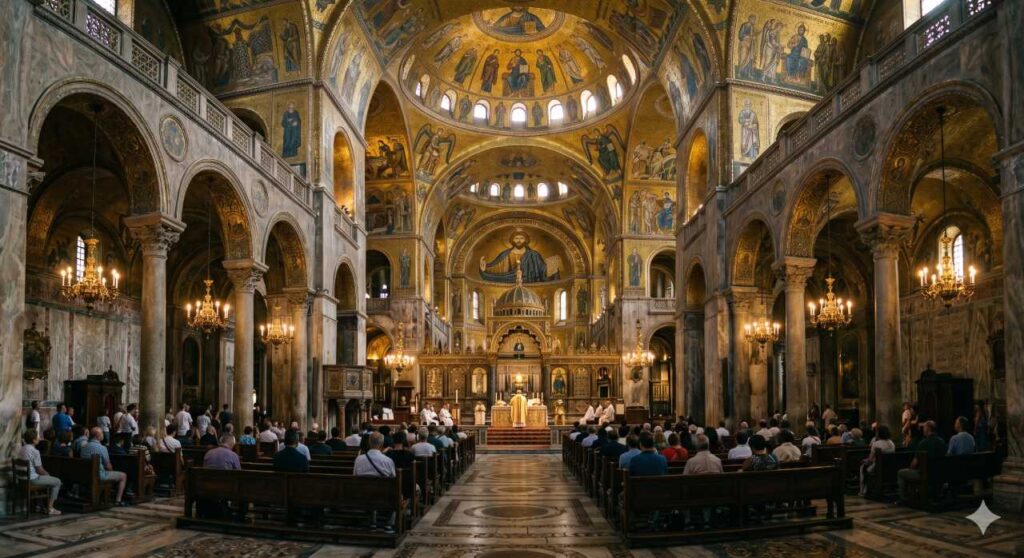
Beyond the mosaics, the church is packed with thousands of square meters of rare marble, precious gems, and looted treasures, solidifying its reputation as a physical manifestation of Venice’s immense maritime wealth.
2. How did Venice actually get the body of St. Mark?
The story of how St. Mark became Venice’s patron saint reads like an 9th-century spy thriller. In 828 AD, two daring Venetian merchants, Rustico da Torcello and Buono da Malamocco, traveled to Alexandria, Egypt, which was under Abbasid Muslim rule. They discovered that the tomb of St. Mark the Evangelist was at risk of being desecrated or dismantled for building materials.
Determined to bring the holy relics back to Venice, the merchants hatched a plan to smuggle the body past Islamic customs officials:
The ship safely cleared port, and the relics arrived in Venice to ecstatic crowds. Doge Giustiniano Participazio immediately ordered the construction of a grand chapel—the first iteration of St. Mark’s Basilica—to house the body, cementing Venice’s status as a major European pilgrimage site.
3. Why does the architecture look more Middle Eastern than Italian?
Unlike the classic Gothic or Romanesque cathedrals found throughout Western Europe, St. Mark’s Basilica looks distinctly Eastern. This is because it was deliberately modeled after the Church of the Holy Apostles in Constantinople (modern-day Istanbul), the capital of the Byzantine Empire.
Venice was originally a vassal state of the Byzantine Empire, and its merchants spent centuries trading in the Levant and Constantinople. The basilica’s architecture features a Greek cross floor plan (four arms of equal length) topped by five massive domes, a characteristic hallmark of Byzantine design. Over the centuries, Venetian architects added Islamic-style ogee arches, Gothic pinnacles, and Romanesque carvings. This unique fusion of styles creates an architectural bridge between the Western Latin world and the Eastern Byzantine/Islamic worlds.
4. What is the story behind the four bronze horses on the facade?
The four majestic bronze horses overlooking St. Mark’s Square are symbols of triumph, theft, and imperial transition. Known as the Triumphal Quadriga, these statues are ancient masterpieces, likely cast in the 4th century BC by a Greek sculptor (some attribute them to Lysippos), though they long decorated the Hippodrome of Constantinople.
During the infamous Fourth Crusade in 1204, the Venetians, led by the blind Doge Enrico Dandolo, sacked Constantinople. Instead of continuing to Jerusalem, they plundered the Christian capital. The bronze horses were shipped back to Venice as ultimate war trophies and mounted on the basilica’s facade to symbolize Venice’s dominance over the old empire.
In 1797, Napoleon Bonaparte conquered Venice and dragged the horses to Paris to sit atop the Arc de Triomphe du Carrousel. Following Napoleon’s defeat, they were returned to Venice in 1815. Today, the horses on the exterior are exact replicas; the fragile originals are preserved safely inside the basilica’s museum.
5. Is it true that St. Mark’s was not always the city’s official cathedral?
Yes. For most of its historic existence, St. Mark’s Basilica was not the official cathedral of Venice. Instead, it functioned as the Doge’s private palace chapel.
The official cathedral of Venice from 775 until 1807 was actually San Pietro di Castello, a church located on an island in a quiet, remote corner of the city. Because the Doge held immense political power, St. Mark’s was used for grand state ceremonies, military celebrations, and political announcements, overshadowing the actual cathedral. It wasn’t until 1807, after the fall of the Venetian Republic and under the orders of Napoleon, that the seat of the Patriarch of Venice was officially moved to St. Mark’s, making it the city’s true cathedral.
6. What lies hidden inside the crypt beneath the high altar?
The crypt of St. Mark’s Basilica is a atmospheric, low-ceilinged underground chamber supported by dozens of ancient marble columns. For centuries, this subterranean space held the direct center of Venetian religious devotion: the tomb of St. Mark.
Because Venice is prone to severe flooding, the crypt has historically been vulnerable to water damage. Following a major fire in 976 and subsequent reconstructions, the exact location of St. Mark’s body was actually forgotten for over a century. According to legend, in 1094, the body miraculously revealed itself when a marble pillar cracked open during a consecration ceremony.
The body remained in the damp crypt until 1811, when it was permanently moved upstairs into a marble sarcophagus beneath the main high altar to protect it from rising waters. Today, the crypt can occasionally be visited, offering a silent, haunting glimpse into the church’s earliest foundations.
7. What makes the Pala d’Oro one of the most expensive objects in the world?
Located directly behind the high altar, the Pala d’Oro (Golden Pall) is a dazzling, universally acclaimed masterpiece of Byzantine and Gothic goldsmithing. It is essentially a massive retable (altar screen) measuring over 3 meters wide and 2 meters high.
What makes it priceless is its unimaginable concentration of precious materials:
First commissioned in Constantinople in 976 AD, it was continuously expanded, enriched, and reworked by Venetian craftsmen over the centuries using looted jewels from the Crusades. It is considered one of the finest surviving examples of Byzantine metalwork in existence.
8. Why is the floor of the basilica so uneven and wavy?
When walking through the basilica, you will immediately notice that the intricate marble floor looks like the surface of a rolling sea, with dramatic dips, waves, and slopes. This is not an intentional artistic choice designed to mimic the Venetian lagoon; it is the result of structural shifting over centuries.
The entire city of Venice, including the basilica, is built on a foundation of millions of wooden piles driven deep into the muddy salt marsh of the lagoon. Over nearly a thousand years, the immense weight of the basilica’s heavy stone walls, marble floors, and massive brick domes has compressed the underlying mud unevenly. Furthermore, centuries of high-tide flooding (acqua alta) have periodically eroded the sub-flooring, causing various sections of the mosaic pavement to sink or buckle.
9. What do the floor mosaics of animals signify?
The basilica’s floor is a breathtaking tapestry of geometric patterns and symbolic animal imagery made from tiny pieces of colored marble (opus sectile). Many of these animals carry deep theological or political allegories:
10. How does the basilica survive the “Acqua Alta” (high tide) floods?
Positioned at one of the lowest points in Venice, St. Mark’s Square and its basilica are the first to flood when high tides roll in from the Adriatic Sea. For decades, water regularly spilled into the narthex (the entrance porch), severely damaging the ancient marble floors and the bases of the historic brick pillars.
Today, the basilica relies on a multi-tiered defense system:
11. What secret room holds the “Treasury” of St. Mark’s?
The Treasury (Il Tesoro) is a highly secure room accessible from the right transept of the basilica. It houses the most valuable portable wealth accumulated by the Republic of Venice over centuries.
The vast majority of the Treasury’s contents consist of plunder brought back by Venetian fleets following the sack of Constantinople in 1204. It contains an unmatched collection of Byzantine chalices, icons, liturgical vessels carved from single blocks of rock crystal, hardstone cups, and intricate reliquaries holding what medieval Christians believed to be pieces of the True Cross, the arm of St. George, and holy thorns from Christ’s crown.
Though much of the gold was melted down by Napoleon in 1797 to pay his troops, the remaining 283 items form the most important collection of Byzantine decorative art in the world.
12. Who is buried inside the basilica besides St. Mark?
While St. Mark is the undisputed central figure of the cathedral, several other notable historical figures are interred within its walls, primarily powerful doges from the golden age of the Republic:
13. What is unique about the musical history of St. Mark’s?
In the 16th and 17th centuries, St. Mark’s Basilica was the birthplace of a revolutionary musical movement known as the Venetian Polychoral Style.
Because the basilica’s interior features multiple choir lofts and balconies facing each other across the transept, composers realized they could experiment with spatial acoustics. Brilliant maestros like Giovanni Gabrieli and Claudio Monteverdi wrote music specifically for these separated galleries.
They placed brass ensembles in one loft and choirs in another, creating a magnificent “surround sound” effect where music echoed back and forth across the golden vaults. This technique, known as cori spezzati (split choirs), laid the groundwork for the development of the dramatic Baroque orchestration we know today.
14. What do the five great domes symbolize?
The five massive domes arranged in a Greek cross pattern – one over the central crossing and one over each of the four arms – represent the union of heaven and earth. In Byzantine theology, a square building represents the earthly world, while a circular dome represents the infinite, perfect circle of heaven.
The domes are named after their principal mosaic themes:
15. How long did it take to build the current basilica?
The building you see standing today is actually the third version of the church. The first was built in 828 to house St. Mark’s body but burned down in a violent palace revolt in 976. A second church was quickly built, but it was deemed too modest for Venice’s soaring ambitions.
Construction on the current, grander basilica began around 1063 AD under Doge Domenico Contarini. The core brick structure was completed and consecrated roughly 30 years later, in 1094. However, a building like St. Mark’s is never truly finished; for the next 700 years, successive doges continuously added marble cladding, Gothic spires, external arches, and new mosaics, making it an architectural project spanning centuries.
16. Why are there columns of different colors and styles outside?
As you approach the main facade of the basilica, you will see a dense, double-tiered forest of more than 500 marble columns. If you look closely, you will notice they are completely mismatched—some are green porphyry, others are red jasper, dark dark-veined marble, or white alabaster, featuring completely different carving styles.
These columns are known as spolia—architectural salvage taken from older buildings. Venetian merchants and naval captains were legally required by state decree to bring back precious stones, marbles, and columns from their trading voyages across the Mediterranean as a tax to decorate the church. Many of these columns were stripped directly from ancient Roman ruins and Byzantine palaces in the Middle East, serving as literal trophies of Venice’s sweeping international reach.
17. What is the significance of the Tetrarchs statue on the corner?
Tucked away on a corner of the basilica near the entrance to the Doge’s Palace sits a strange, dark-red porphyry sculpture of four embracing figures known as the Portrait of the Four Tetrarchs.
Dating back to around 300 AD, this statue represents the political system established by Roman Emperor Diocletian, who divided the massive Roman Empire into four administrative zones, ruled by two senior emperors (Augusti) and two junior emperors (Caesars). The figures are shown gripping their swords with one hand and embracing each other with the other, symbolizing solidarity and shared power.
Like so much else, the Venetians stole this statue from Constantinople during the 1204 Crusade. In a funny twist of archaeological history, the missing foot of one of the tetrarchs was discovered by archaeologists in Istanbul in the 1960s, confirming its original home.
18. Can you go up into the balconies, and what can you see from there?
Yes, visitors can purchase a ticket to the upper level, which houses the St. Mark’s Museum (Museo di San Marco). Going upstairs is highly recommended for two major reasons:
19. Why does St. Mark’s have a separate bell tower?
In traditional Italian architecture, it was common practice to construct the bell tower (campanile) as a completely freestanding structure separate from the main church body, rather than attaching it directly to the facade.
The St. Mark’s Campanile stands 98.6 meters (323 feet) tall in the piazza. It originally served a dual purpose: a belfry for the cathedral and a lighthouse for ships returning to the lagoon. The tower has a dramatic history of its own; after centuries of damage from lightning strikes and earthquakes, it unexpectedly collapsed entirely into a neat pile of rubble on July 14, 1902. Remarkably, no one was killed except for the caretaker’s cat. The city immediately voted to rebuild it exactly “where it was and how it was” (com’era, dov’era), completing the current tower in 1912.
20. What are the rules and best tips for visiting today?
Because St. Mark’s Basilica is an active place of worship and a highly sensitive historical site, there are strict rules you must follow to gain entry:
| Requirement | Rules & Details |
|---|---|
| Dress Code | Both men and women must cover their shoulders and knees. Tank tops, shorts, and short skirts are strictly prohibited. |
| Baggage | Large bags, backpacks, or suitcases are not allowed inside. You must check them at a nearby luggage storage facility before lining up. |
| Photography | Photography and videography are strictly prohibited inside the main ground floor area to maintain an atmosphere of reverence. |
| Best Time to Visit | Early morning just before opening, or late afternoon when the tour groups disperse. |
| Lighting Tip | The golden mosaics are fully illuminated by electric spotlights for only a short window each day (usually between 11:30 AM and 12:45 PM on weekdays). Planning your visit during this window completely transforms the visual experience. |