
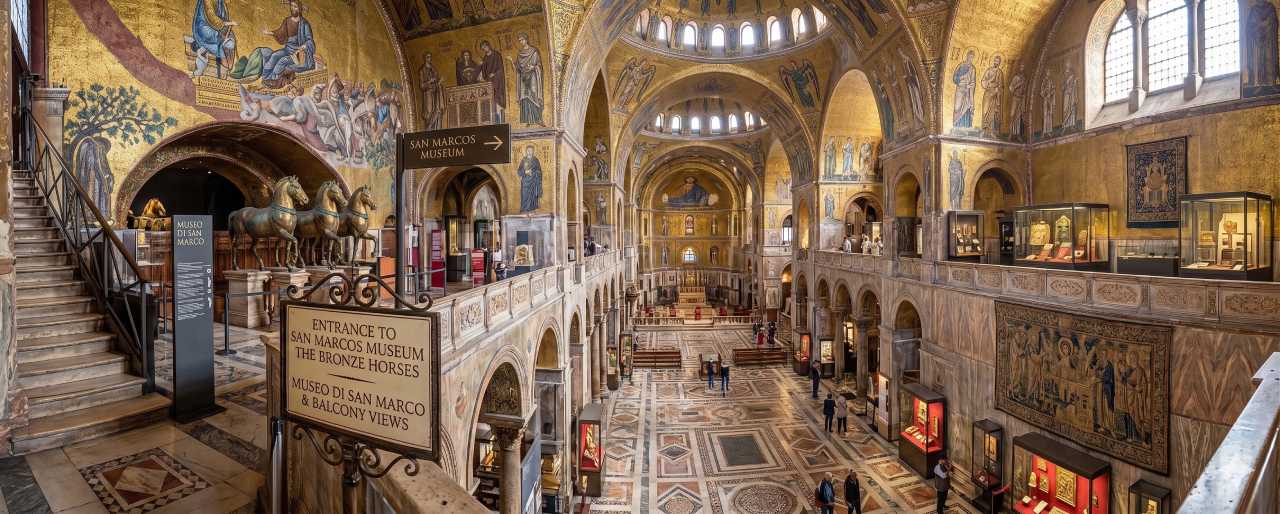
Stepping into St. Mark’s Basilica (Basilica di San Marco) for the first time is an experience that leaves you momentarily breathless. Your eyes automatically travel upward, pulled by the sheer, shimmering weight of thousands of square meters of 24-karat gold mosaics.
Below your feet, an undulating, waves-of-stone marble floor tells centuries of stories. But as I stood in the nave during my visit, dodging the slow-moving flow of the main crowd, I realized that the vast majority of visitors miss out on the real heart of this monument. They walk through the ground-level loop, look up, snap a mental picture, and exit back out into the bright Venetian sun.
They are missing the staircase. Tucked away toward the right side of the main atrium (the narthex) is a steep, unassuming, and somewhat narrow flight of stone steps. It leads upward, away from the shuffle of the crowds below, straight into the San Marcos Museum (Museo di San Marco).
Having spent a rainy afternoon exploring every nook, cranny, and artifact hidden on this upper level, I can say without a shred of doubt that this is the single best part of visiting the entire basilica complex. If you want to truly understand why Venice exists in the way it does, how it accumulated its unimaginable wealth, and what secrets lie behind those famous golden walls, you need to climb those stairs.
| St Mark’s | Price | Ticket |
|---|---|---|
| Entrance + Pala d’Oro + Terrace | €29.49 | Book Online |
| Guided Tour | €31.90 | Book Online |
| Entrance + Doge’s Palace | €69.90 | Book Online |
| Entrance + Bell Tower | €56.00 | Book Online |
| St. Mark’s Square Pass | €86.90 | Book Online |
| The Venice Pass | €92.50 | Book Online |
The best option is to buy your main entry ticket directly on this website to secure your spot and skip the long lines at the entrance. Once you are comfortably inside the Basilica, you can easily purchase your museum ticket right at the stairs for just €7.
Where is the Museum Located and What is the Concept?
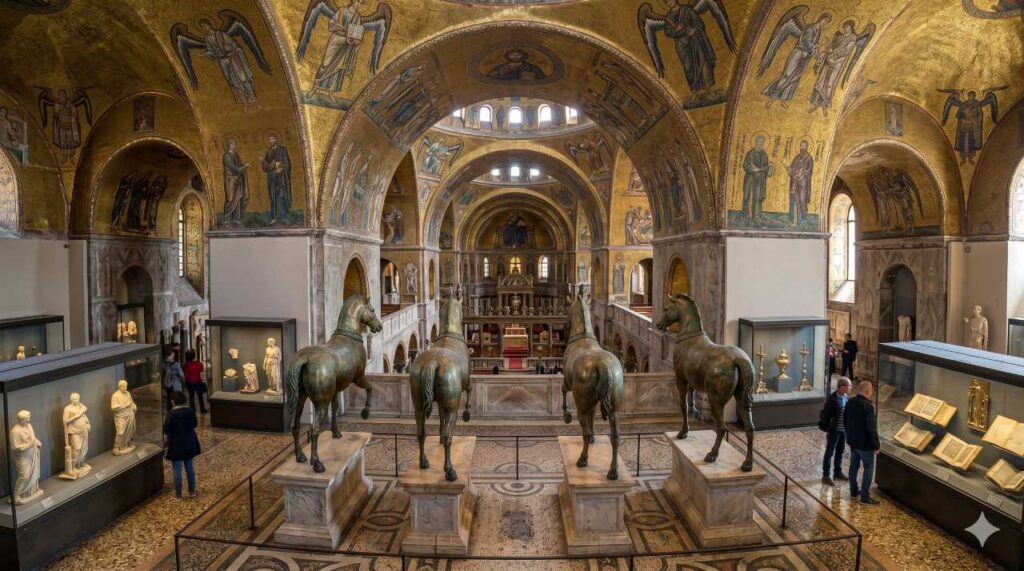
To clear up any initial confusion right off the bat: yes, the San Marcos Museum is entirely inside the basilica. Specifically, it occupies the upper floor, galleries, and former banqueting halls that look directly down over the church interior and out onto Piazza San Marco.
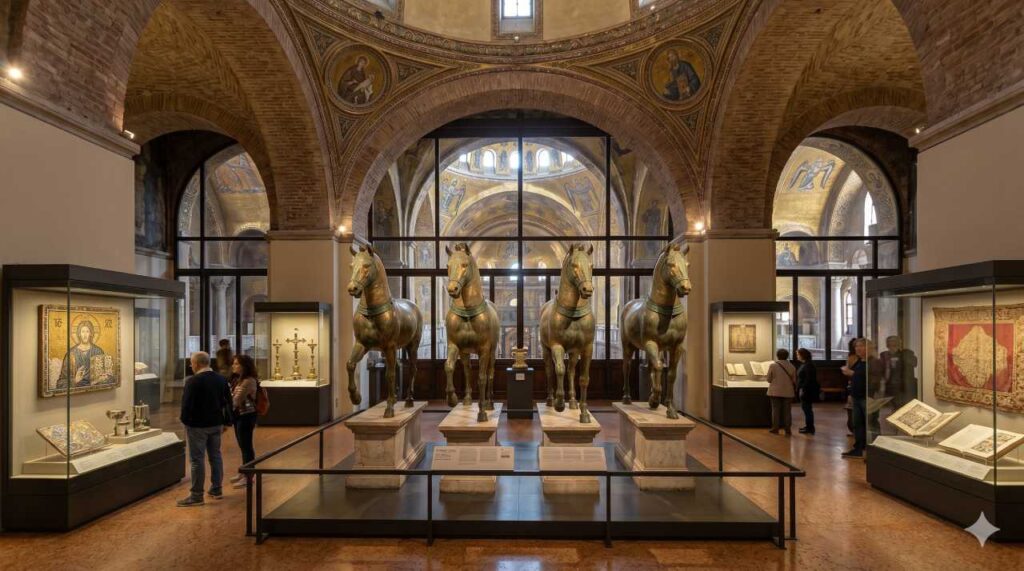
The concept of the museum is brilliantly multi-layered. It is not just a room filled with dusty glass display cases; it is an architectural journey through the history of Venice as a maritime superpower. When you walk through the museum, you are walking through the historic choir galleries where the Doge (the ruler of Venice) and high-ranking Venetian nobility would sit during grand state ceremonies.
Why is There a Museum of the San Marcos Basilica?
To understand the existence of this museum, you have to understand that St. Mark’s Basilica was not originally the official cathedral of Venice. For most of its life, from its founding in the 9th century until 1807, it functioned as the Doge’s private state chapel. It was a physical manifestation of Venetian pride, geopolitical dominance, and divine favor.
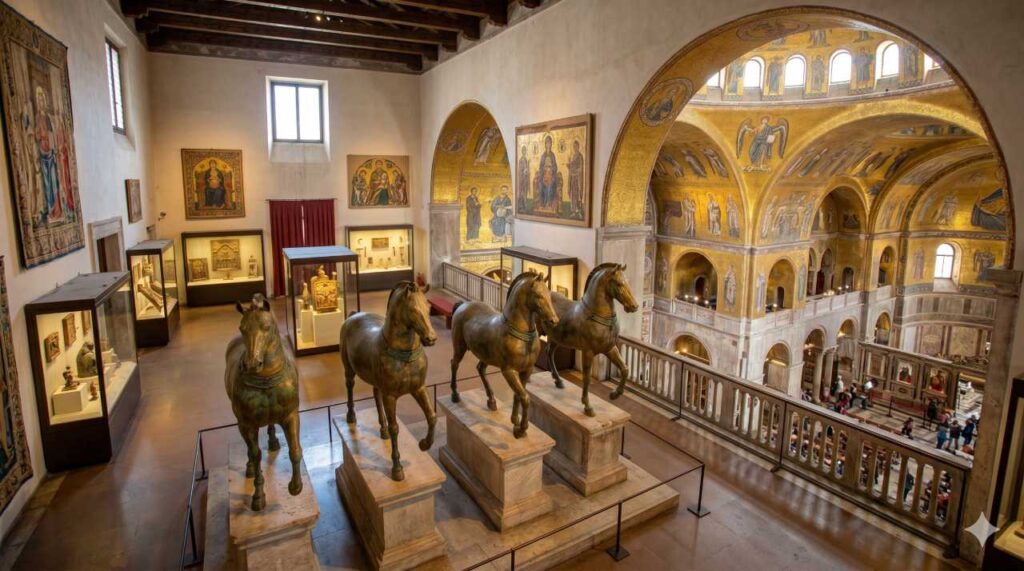
Whenever Venetian merchants, admirals, or crusaders sailed out into the Mediterranean, they brought back “gifts.” Many of these items were, to put it bluntly, spoils of war, political thefts, or exotic trade treasures. The basilica became a massive, living treasure chest.
Over the centuries, as the church survived fires, restructuring, political collapses, and environmental threats, church authorities realized that keeping all of these priceless historical treasures exposed to crowds and changing weather was an existential risk.
The museum was created to preserve, contextualize, and display these legendary pieces. It serves as a historical repository where you can unpack the dizzying mix of Byzantine, Western European, and Islamic influences that shaped Venetian art. Without this dedicated museum space, many of the world’s most important surviving medieval artworks would have degraded into dust long ago.
What is There to See in the San Marcos Basilica Museum?
The museum’s collection is sprawling, but it builds toward a crescendo that will leave any history lover completely awe-struck. As you wander through the interconnected stone rooms and open galleries, several world-class highlights demand your time:
1. The Original Horses of Saint Mark (The Triumphal Quadriga)
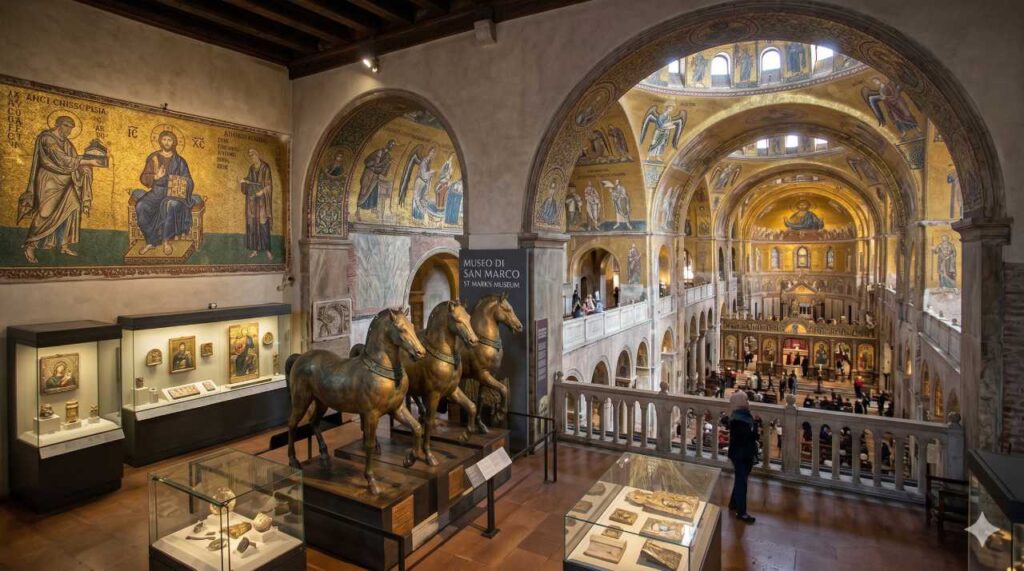
This is the crown jewel of the collection, and the primary reason most travelers make the trek upstairs. Standing in a dedicated, climate-controlled, dimly lit room are the four original, monumental bronze horses. These majestic sculptures are ancient—likely cast in the 4th century BC or 4th century AD—and they are the only surviving team of horses from classical antiquity.
2. Up-Close Mosaic Encounters and Fragment Displays
On the ground floor, the mosaics are a distant, glittering sky. In the museum, you can walk along the internal loggia corridors and see them at arm’s length. You can observe the exact craftsmanship: the way the gold leaf is sandwiched between layers of glass, and how the stones are slightly tilted to manipulate light.
Furthermore, the museum features a fascinating collection of authentic medieval mosaic fragments. When sections of the walls were damaged by earthquakes or structural settling over the past 800 years, restorers carefully detached the pieces. Seeing these faces, hands, and decorative borders separated from the walls allows you to appreciate the raw artistry and scale of medieval mosaic work in a way that is impossible from the church floor.
3. Grand Tapestries and Sacred Textiles
As you move deeper into the former banqueting rooms, you enter a space filled with magnificent textiles. The standout exhibits here are the 16th-century tapestries depicting the Passion of Christ, woven out of silk, wool, silver, and gold threads. They based these tapestries on drawings by the famous Venetian master Sansovino. The colors are remarkably preserved, offering a glimpse into the luxurious textures that once draped the stone interior during high religious holidays. There are also incredibly rare Byzantine liturgical vestments embroidered with minuscule, painstaking detail.
4. Illuminated Manuscripts and the Treasury of Liturgy
For those who appreciate the written word and book arts, the museum preserves a collection of giant choral books and illuminated manuscripts. These books are massive, hand-painted objects with brilliant lapis lazuli blues and vibrant reds, used by the basilica’s choirs centuries ago. Seeing the giant musical notation designed to be read by a group of singers standing feet away puts you right into the shoes of a medieval Venetian chorister.
Is It Worth Paying to Enter? Is It a Great Experience?
Let’s talk about the practical reality of visiting Venice. The city can feel incredibly crowded, expensive, and overwhelming. When you are standing inside the main nave of the basilica, you are often being gently corralled along a specific path by staff members keeping the crowd moving. You cannot pause for too long, you cannot take it all in, and the noise level can be quite high.
Because of this, paying the small additional fee to enter the San Marcos Museum is one of the best value-for-money decisions you can make in Venice.
In short, yes, it is an absolutely fantastic experience. If you skip the museum, you are only seeing half the story of St. Mark’s, and arguably the less interesting half.
How Much Time Does It Take to Visit the Museum?
Time management is crucial when trying to navigate a jam-packed Venetian itinerary. Because the museum is integrated directly into the upper levels of the structure, you want to budget your time wisely so you don’t feel rushed.
What Are the Opening Hours of the Museum?
The San Marcos Museum operates in alignment with the general opening hours of the basilica itself, but there can sometimes be minor variations depending on religious services, seasonal shifts, and conservation work.
Generally speaking, the museum is open daily from 9:30 AM to 5:15 PM.
However, a vital insider tip for planning your trip involves Sundays and major religious holidays. On these days, the ground floor of the basilica is often closed to casual tourists in the morning for Holy Mass, or has highly restricted hours. The museum up top sometimes maintains its accessibility or opens slightly later in the afternoon. Always check the current official schedule for the specific date of your visit to ensure you don’t hit any unexpected closures, as active worship takes absolute precedence inside this living church.
Understanding the Strict Dress Code
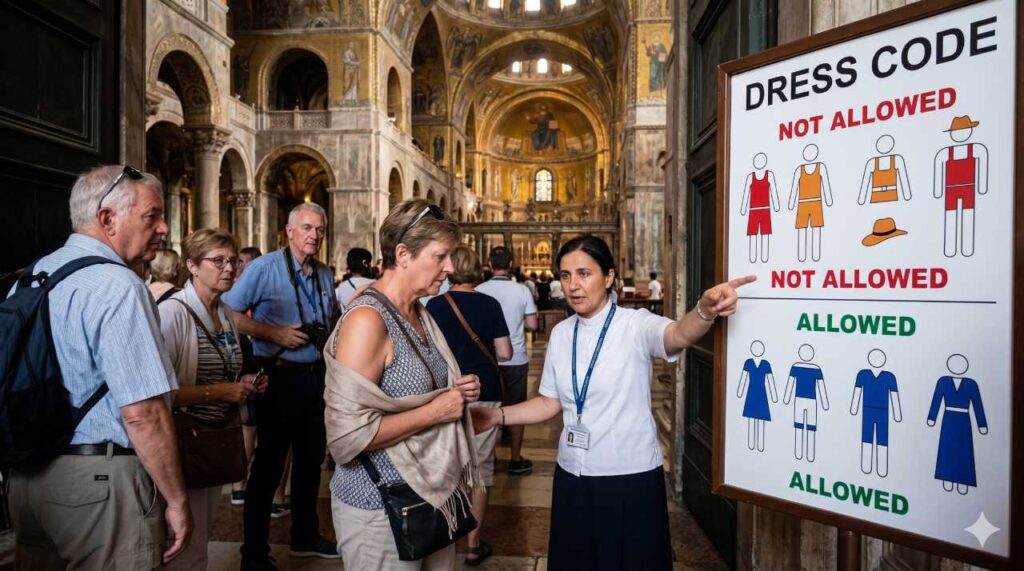
Because St. Mark’s Basilica is an active, sacred Roman Catholic place of worship, there is a non-negotiable dress code that applies to every single area of the building, including the upstairs museum. Church guardians at the main entrance are incredibly strict, and they will turn you away without a second thought if you are not dressed appropriately, regardless of whether you have pre-purchased tickets.
To avoid disappointment, heartbreak, and a ruined afternoon, keep these absolute rules in mind:
Before you final pack your day bag or get dressed for your day out in the canals, it is highly recommended to read through the complete, detailed breakdown of rules on the official St. Mark’s Basilica Dress Code Guide. It gives excellent visual examples and alternative solutions so you can guarantee smooth, hassle-free entry past the front guards.
Museum vs. Terrace: Which is Better?
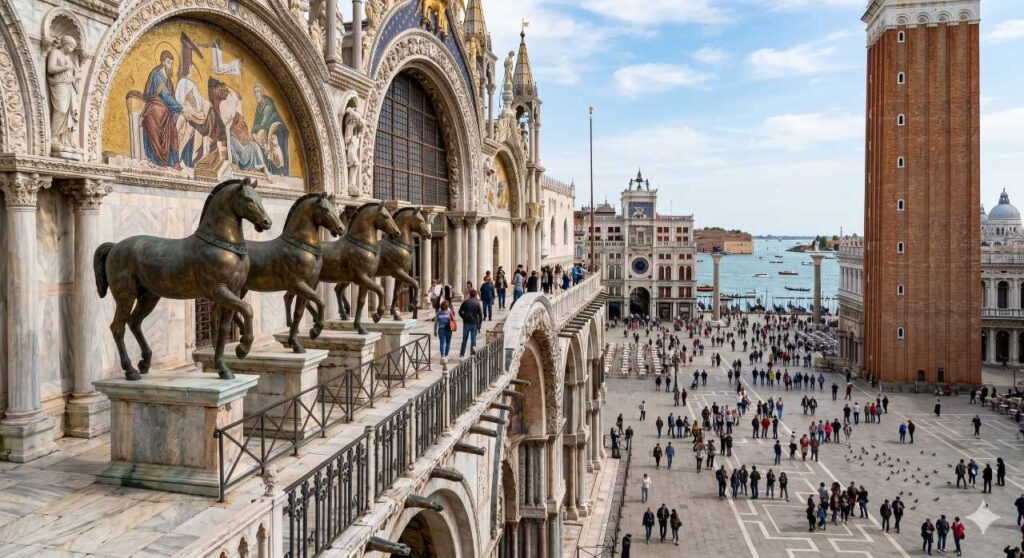
A common question that pops up among travelers looking over ticket descriptions is whether they should focus their attention on the indoor museum rooms or the open-air outdoor terrace. The simple answer is: you don’t have to choose, because they are packaged together! The museum entrance pathway naturally flows right out onto the external loggia.
However, if we are evaluating the two spaces based on what makes each unique, they offer completely contrasting thrills.
The indoor museum gives you the deep, intimate historical context, the silence, and the incredible privilege of standing face-to-face with the ancient bronze horses.
The outdoor terrace, on the other hand, gives you the absolute best panoramic view in all of Venice. Stepping out through the heavy doors onto the stone balcony puts you directly above Piazza San Marco. From here, you can look straight down at the bustling square, watch the pigeons swirl around the historic cafes, look directly across at the majestic Campanile (bell tower), and gaze out over the shimmering waters of the Venetian Lagoon toward the island of San Giorgio Maggiore. You also get an up-close look at the exterior architectural flourishes, the Gothic spires, and the replicas of the bronze horses standing proud against the sky.
If you want to compare the logistical details, photo opportunities, and structural highlights of these two interconnected spaces to help map out your time on the upper level, take a look at the comprehensive comparison on The St. Mark’s Basilica Terrace Exploration Page. It highlights exactly why missing either half of this upper level would be an incomplete journey.
Are You Going Through the Museum When Taking a Guided Tour?
When booking a trip to St. Mark’s, many people opt for a guided tour to help break down the overwhelming amount of art and history. However, you must read the fine print of your specific tour itinerary very carefully.
If you are currently shopping around for the perfect itinerary and want to know exactly what is included, check out the various booking paths and structural breakdowns on the St. Mark’s Basilica Guided Tour Information Page. Choosing a tour that incorporates the upper museum saves you time, streamlines your tickets, and ensures you don’t miss out on the expert commentary that brings those ancient bronze horses to life.
Uncovering the Unknown Facts of the Basilica
One of the most satisfying elements of exploring the San Marcos Museum is discovering the bizarre, mysterious, and frequently shocking history behind the church’s construction and preservation. The basilica is wrapped in layers of legends, political schemes, and architectural anomalies that are not obvious when you are just wandering around on your own.
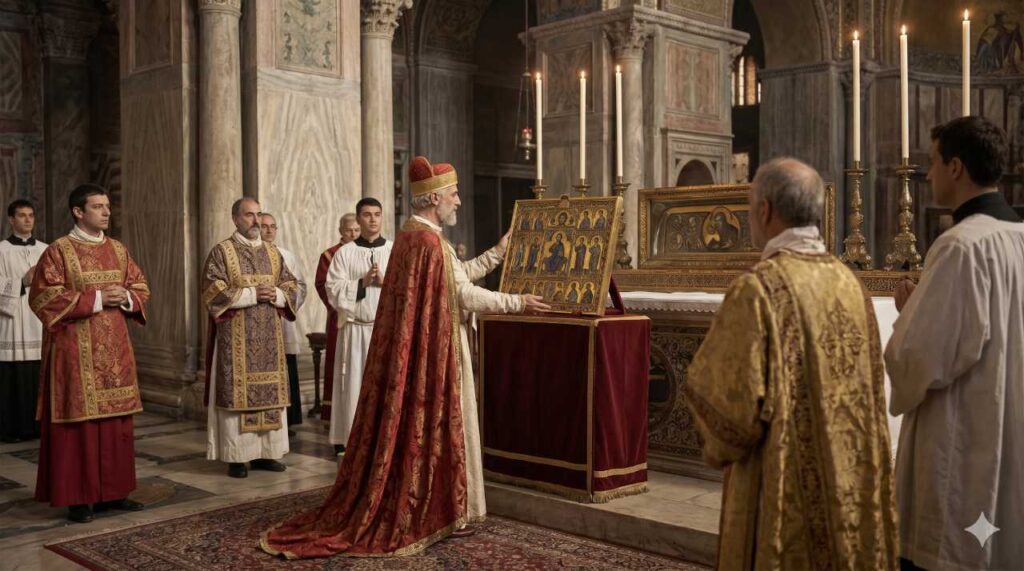
Fortunately, the museum serves as the primary educational hub where these fascinating historical mysteries are unpacked and explained. Through detailed historical timelines, ancient models, structural drawings, and rescued artifacts, the museum clears up several legendary questions:
If you love weird history, secret anomalies, and behind-the-scenes accounts that sound too wild to be true, you will be fascinated by the full archive compiled on the St. Mark’s Basilica Unknown Facts Guide. Reading up on these stories before you enter the museum will completely transform the way you look at the building’s walls, chambers, and artifacts.
Practical Tips for an Unforgettable Museum Visit
To wrap up this firsthand review, here is a concise, easy-to-remember list of practical takeaways that will help you execute a flawless, stress-free visit to the upper floor of St. Mark’s Basilica:
The San Marcos Museum is not an optional add-on; it is the definitive key to understanding Venice.
By climbing those stairs, you step away from the surface-level tourist experience and step directly into the raw, glittering, and complicated history of the Venetian Republic.
It is calm, visually spectacular, deeply educational, and worth every single minute of your time.