
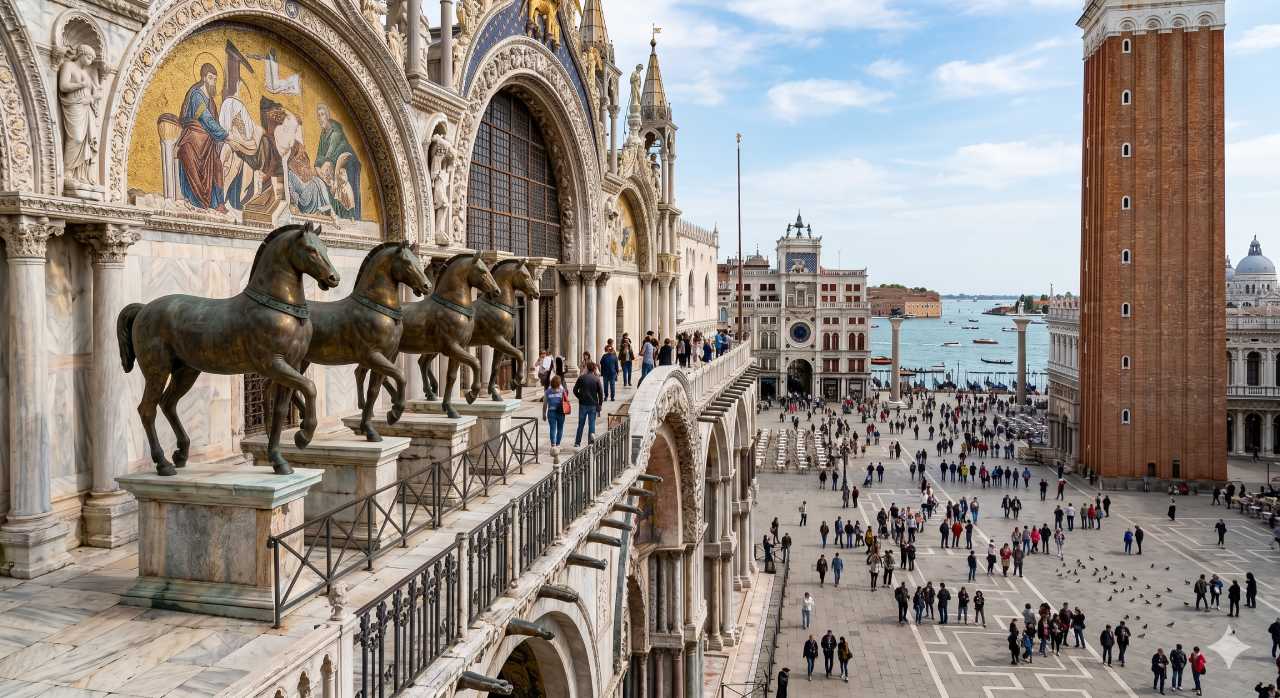
The architectural landscape of Venice is defined by its deep-rooted relationship with maritime trade, political theatre, and Eastern Roman influences. At the structural core of this narrative stands the Loggia Veneziana, commonly referred to as the Terrace of St. Mark’s Basilica.
This elevated stone platform, which divides the lower and upper registers of the western facade, is far more than a scenic overlook. It is a monument of political propaganda, civic ritual, and historical display that has evolved continuously since its inception in the Middle Ages.
| St Mark’s | Price | Ticket |
|---|---|---|
| Entrance + Pala d’Oro + Terrace | €29.49 | Book Online |
| Guided Tour | €31.90 | Book Online |
| Entrance + Doge’s Palace | €69.90 | Book Online |
| Entrance + Bell Tower | €56.00 | Book Online |
| St. Mark’s Square Pass | €86.90 | Book Online |
| The Venice Pass | €92.50 | Book Online |
Why is There a Terrace on St. Mark’s Basilica in Venice?
To understand why the terrace exists, one must examine the unique sociopolitical function of St. Mark’s Basilica during the Venetian Republic. Unlike the traditional grand cathedrals of Rome or Florence, St. Mark’s was not the official seat of the local bishop for most of its history. Instead, it operated as the Doge’s private palace chapel and a state sanctuary. Consequently, the architecture of the building was specifically engineered to project the divine authority of the Venetian state and its leader, the Doge.
The Architectural Blueprint of Authority
The current layout of the Basilica was constructed primarily between the 11th and 15th centuries under the guidance of Doge Domenico Contarini, drawing heavily upon Byzantine architectural forms—specifically the Church of the Holy Apostles in Constantinople (Kalit, 2013). The western facade was intentionally designed with a split-level composition. The protruding ground level, which contains five massive rounded arch portals, is separated from the upper Gothic level by a wide, balustraded stone terrace running the full 52-meter width of the structure (Kalit, 2013).
Architecturally, the terrace serves a vital structural and aesthetic purpose. It provides a visual transition between the heavy, column-dense Romanesque-Byzantine lower tier and the lighter, highly decorative Gothic pinnacles and lead-covered domes above (Kalit, 2013). Without this horizontal break, the complex intersection of distinct historical styles would lose its compositional harmony.
A Stage for State Rituals
Beyond structural aesthetics, the terrace functioned as an open-air theater for public statecraft. In a republic where the appearance of stability and continuity was vital, the Doge and the Signoria (the supreme governing body of Venice) needed a prominent space to communicate directly with the populace assembled in Piazza San Marco below.
The Display of Imperial Spolia
Perhaps the most critical reason for the terrace’s existence was the display of spolia—architectural fragments, marbles, and sculptures plundered from defeated rival territories, particularly during the Crusades (Lazzarini, 2023). Venetians did not merely collect these artifacts to hide them away in private treasuries; they integrated them directly into the external fabric of their state chapel to serve as permanent public monuments of military dominance (Lazzarini, 2023).
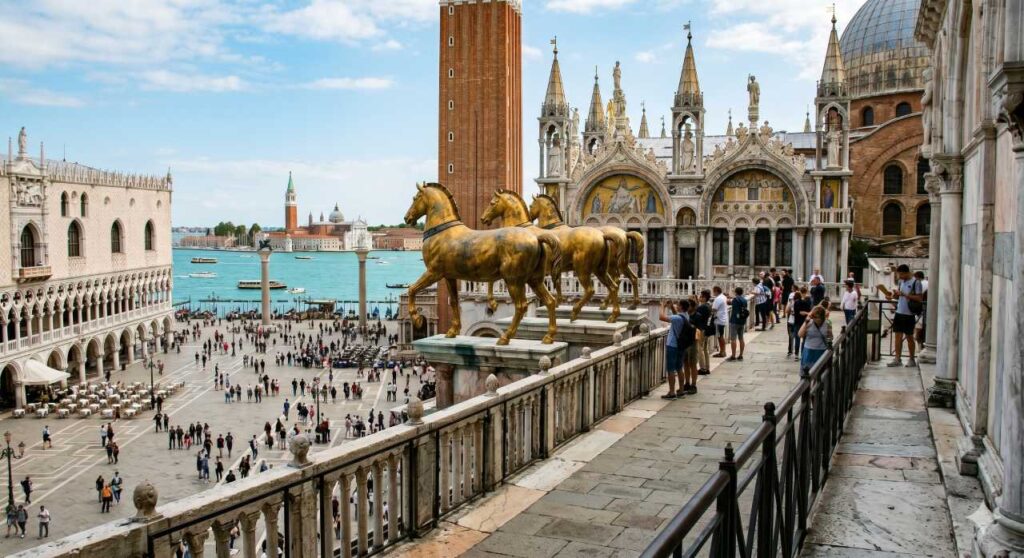
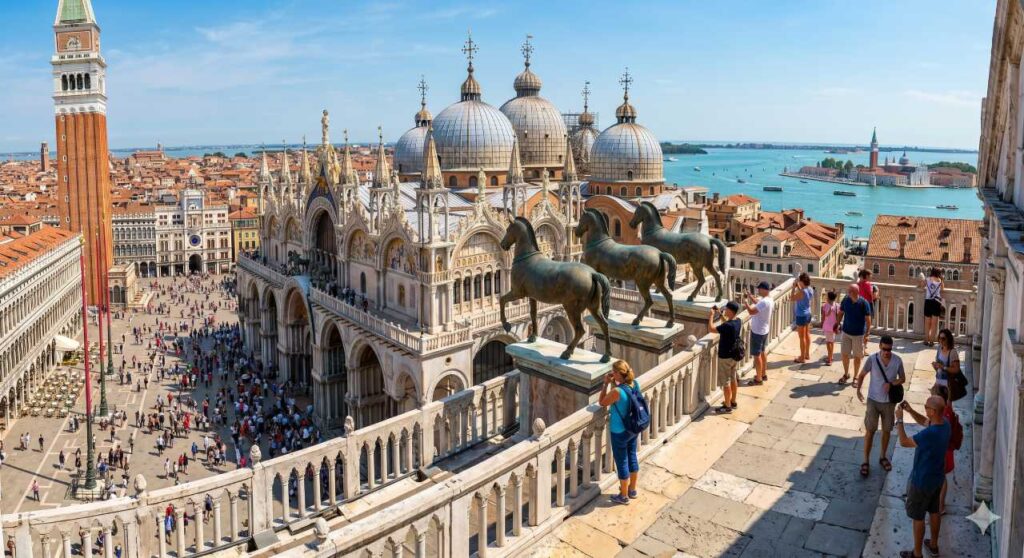
The terrace was designed to showcase the ultimate prize of the Fourth Crusade: the four gilded copper horses stolen from the Hippodrome of Constantinople in 1204 during the sack of the city under Doge Enrico Dandolo (Kalit, 2013). Placed prominently on the central axis of the terrace around 1250, these massive sculptures transformed the church facade into a triumphal monument, signaling to all who entered the square that the Republic of Venice had effectively inherited the mantle of the Eastern Roman Empire (Kalit, 2013).
Is it Worth Going to the Terrace of the St. Mark’s Basilica?
For anyone looking to fully digest the historical, artistic, and spatial reality of Venice, ascending to the terrace is widely considered an indispensable part of the visit. While the ground floor of the Basilica offers a profound look into the dark, glittering interior of golden mosaics, the terrace provides an entirely different contextual layer that bridges the interior art with the exterior urban plan of the city.
Unparalleled Spatial Perspectives
From the ground of Piazza San Marco, the scale of the square can feel overwhelming, and the intricate details of the Basilica’s upper tiers are lost to perspective distortion. Stepping onto the terrace completely shifts this dynamic. Visitors are brought eye-level with the complex iconography of the upper facade, allowing for close-range observation of the stone carving, marble veneering, and mosaics that define the building’s exterior.
Furthermore, it offers the definitive vantage point of the piazza itself. Looking outward from the balustrade, the geometric design of the pavement, the alignment of the Procuratie buildings, and the relationship between the Basilica and the Doge’s Palace become clear. It transforms the square from a crowded tourist destination into a legible piece of deliberate, Renaissance-era urban engineering.
The Gateway to the Museo Marciano
Access to the terrace is intrinsically tied to the Museo Marciano (the St. Mark’s Museum), which occupies the upper galleries of the church. To reach the outdoor loggia, visitors must pass through the museum spaces, meaning the experience provides a comprehensive educational return. It is within these climate-controlled upper rooms that the most sensitive, historical treasures of the Basilica are preserved, making the journey upstairs doubly valuable for those invested in medieval history and art preservation.
What is There to See on the Terrace of the St. Mark’s Basilica?
The terrace is not a simple concrete viewing deck; it is a dense gallery of historical artifacts, architectural features, and sweeping panoramic views.
The Triumphal Quadriga (The Bronze Horses)
The defining feature of the terrace is the Quadriga—the four monumental statues of horses that stand directly above the main central portal of the facade (Kalit, 2013).
| Attribute | Exterior Quadriga | Interior Quadriga |
|---|---|---|
| Status | Modern exact replica | Authentic ancient artifact |
| Material | Weather-resistant alloy | Gilded copper-bronze (antique) |
| Location | Exposed on the open-air loggia | Protected inside the museum gallery |
| Primary Value | Preserves architectural & visual context | Preserves material history & artistic details |
Close-Up Views of Upper Facade Elements
Standing on the loggia brings visitors within arm’s reach of the architectural elements of the upper facade, which are largely illegible from the ground:
Panoramic Views of the Marciana Area
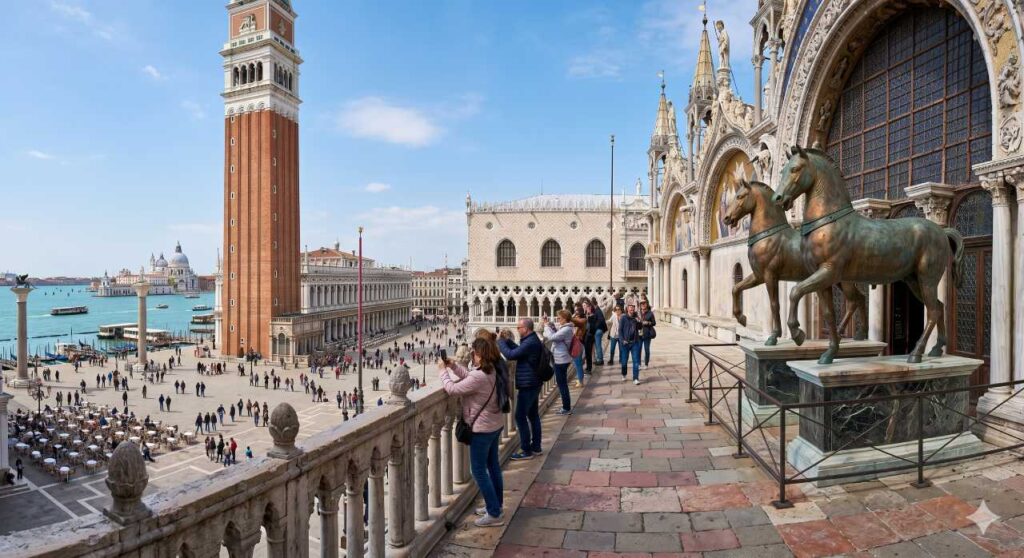
Turning away from the church facade, the terrace offers a 180-degree panoramic view of the civic beating heart of Venice:
How Much Time Do You Have to Spend on the Terrace to See Everything?
The time required to fully experience the terrace depends largely on whether a visitor views it simply as a photo opportunity or intends to study the associated museum collections. Because access to the outdoor terrace is structurally unified with the interior museum gallery, the time spent covers both areas.
The Focused Visit: 30 to 45 Minutes
For the average traveler who wants to step outside, walk the length of the loggia, take photographs of the panoramic views, examine the replica horses, and spend a few minutes looking at the original horses inside the museum room, 30 to 45 minutes is sufficient. This pace allows for a relaxed walk across the stone platform without feeling rushed, with ample time to absorb the spatial transition from the church interior to the open city square.
The Historical / Scholarly Visit: 1 to 1.5 Hours
For art historians, architecture enthusiasts, or those utilizing detailed audio guides, a visit can easily extend to 60 or 90 minutes. This deeper dive involves:
Explain the Opening Times of the Terrace of the St. Mark’s Basilica
The operating schedule of the terrace is highly regulated to balance heavy global tourism with the preservation needs of an active, fragile place of worship. Because the terrace is accessed exclusively through the Museo Marciano, its operating hours match those of the museum rather than the lower church floor.
Standard Seasonal Schedules
The opening times fluctuate depending on the tourist seasons, which are divided into summer (peak season) and winter (low season):
Sunday and Holy Day Variances
Because St. Mark’s is a functioning cathedral, religious services take priority over tourism. On Sundays and major Catholic Holy Days (such as Christmas, Easter, and the Assumption), the lower floor of the basilica is frequently closed to casual tourists in the morning for solemn high mass.
However, the Terrace and Museum often maintain their standard morning operating hours (opening at 09:30 AM) on these days. This is because the upper galleries are physically separated from the main nave and choir floor, allowing tourists to explore the museum and outdoor balcony via a dedicated staircase without disrupting the liturgical services occurring below.
Operational Advisory: While the terrace remains open during regular rain, extreme weather events unique to Venice—specifically Acqua Alta (tidal flooding)—can disrupt access. While the terrace itself is high above the water line, severe flooding can flood the ground-floor atrium entryways, causing temporary safety closures of the entire basilica complex until the tides recede.
1. Do I need a separate ticket to visit the terrace?
Yes. Access to the terrace is not included with the standard entry to the ground floor of the Basilica. Because the terrace is physically part of the Museo Marciano (St. Mark’s Museum) located in the upper galleries, you must purchase a ticket that grants access to the museum to go out onto the balcony.
2. Is there an elevator to the terrace, or do you have to climb stairs?
There is no elevator available for general public use. To reach the upper gallery and the terrace, visitors must climb a steep, narrow, and winding stone staircase consisting of roughly 40 to 45 steps. Because of the historical architecture, the climb can be challenging for those with mobility issues or severe vertigo.
3. Are the horses on the outside terrace real?
No, the four bronze horses standing on the exterior terrace are exact, modern replicas. The authentic, ancient Roman sculptures—known as the Triumphal Quadriga—were moved indoors to a climate-controlled room inside the St. Mark’s Museum to protect them from air pollution, acid rain, and environmental degradation.
4. Can you go on the terrace when it rains or during Acqua Alta?
The terrace remains open during normal rainy weather. However, if Venice experiences extreme Acqua Alta (high tide flooding) that inundates the ground-floor atrium of the Basilica, the entire complex may temporarily close for safety. If it is safely accessible, the stone terrace can become slippery when wet, so sturdy footwear is highly recommended.
5. Can I see the inside of the Basilica from the upper level?
Yes. Before stepping outside onto the exterior terrace, the museum pathway takes you through the internal upper galleries of the Basilica. From these elevated interior balconies, you get an exceptional, close-up look at the vaulted ceilings and the millions of glittering gold glass tesserae that make up the upper mosaics, looking down over the main church floor.
6. Is photography allowed on the terrace?
Yes, photography and video recording for personal use are permitted on the outdoor terrace. It is one of the most popular photo spots in Venice, offering unobstructed views of Piazza San Marco and the Lagoon. However, please note that photography is strictly prohibited inside certain areas of the main church below.
7. What is the best time of day to visit the terrace?
The best time to visit is early in the morning (right when it opens at 09:30 AM) or late in the afternoon (about an hour before closing). During mid-day, the terrace can become crowded, making it harder to move along the narrow stone walkways. Late afternoon also offers softer, warmer lighting across the piazza for photography.
8. Is there a dress code for the terrace?
Because the terrace is accessed by walking through the upper galleries of an active place of worship, the Basilica’s strict dress code applies to the entire visit. Both men and women must have their shoulders and knees covered. Large backpacks, luggage, and bulky bags are also prohibited inside the building and must be left at the official luggage deposit.
9. Is the terrace wheelchair accessible?
Unfortunately, no. Due to the strict preservation laws governing the 1,000-year-old Byzantine structure, a public lift or ramp system has not been integrated into the steep stone staircases leading to the upper museum level. The experience is not accessible to wheelchair users or those unable to climb steep steps.
10. Does the terrace close early on Sundays for church services?
No. While the ground floor of the Basilica is often closed to tourists on Sunday mornings for Holy Mass, the upper museum and terrace usually maintain their regular opening hours. The entrance staircase bypasses the main liturgical space, meaning you can typically tour the terrace even while Sunday services are actively being held below.